
Tsunami. A tsunami (plural: tsunamis or tsunami; from Japanese: 津波, lit.
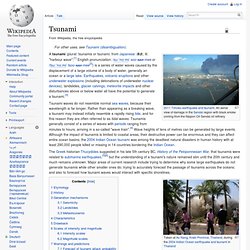
"harbour wave";[1] English pronunciation: /suːˈnɑːmi/ soo-NAH-mee or /tsuːˈnɑːmi/ tsoo-NAH-mee[2]) is a series of water waves caused by the displacement of a large volume of a body of water, generally an ocean or a large lake. Earthquakes, volcanic eruptions and other underwater explosions (including detonations of underwater nuclear devices), landslides, glacier calvings, meteorite impacts and other disturbances above or below water all have the potential to generate a tsunami.[3] The Greek historian Thucydides suggested in his late 5th century BC, History of the Peloponnesian War, that tsunamis were related to submarine earthquakes,[5][6] but the understanding of a tsunami's nature remained slim until the 20th century and much remains unknown.
Etymology The term tsunami comes from the Japanese 津波, composed of the two kanji 津 (tsu) meaning "harbour" and 波 (nami), meaning "wave". History Generation mechanisms Seismicity where. What is a tsunami? Kyodo News/AP Earthquake-triggered tsumanis sweep shores along Iwanuma in northern Japan on Friday.

One of the largest earthquakes ever recorded shook Japan, killed hundreds and unleashed a worldwide natural disaster - a ferocious tsunami. A tsunami, which in Japanese means "harbor wave," is sparked by a strong motion on the ocean floor, usually by an earthquake, a volcanic eruption or an underwater landslide. In Japan's case, there was an earthquake where chunks of the Earth's crust separated under the seafloor, causing the massive, 8.9-magnitude quake. Earthquakes cause not just a single wave but a series that acts like the waves rippling from a stone dropped in a pond. Each wave can last from five to 15 minutes. Experts say the subsequent waves are hard to predict because it's difficult to know how an earthquake has affected the seafloor until hours, days or sometimes months after the event.
Tsunamis are sparked by a strong motion on the ocean floor. Ashahid@nydailynews.com. Tsunami secrets. Destructive Power of Tsunami Waves. EQ Trigger Tsunamis- how? The massive magnitude 8.9 earthquake that struck near the east coast of Honshu, Japan's main island, at 2:46 P.M. local time and unleashed a fierce tsunami claiming hundreds of lives is already being felt as far away as the west coast of North America, about 8,000 kilometers away.

Much of this has to do with the depth of the ocean that the tsunamis waves traversed as well as the sheer size of the quake, which was the strongest recorded in Japan's history. The tsunami hit Hawaii about seven hours after it washed away entire towns along Japan's northern coast. Whereas the waves that struck Japan have been reported as high as seven meters, Hawaii was spared serious damage. Still, the threat of the tsunami closed ports in Honolulu and Guam and led to warnings, watches and coastal evacuations in 20 countries, including the U.S., Indonesia and Chile. Seawall. A seawall (or sea wall) is a form of coastal defense constructed where the sea, and associated coastal processes, impact directly upon the landforms of the coast.

The purpose of a seawall is to protect areas of human habitation, conservation and leisure activities from the action of tides and waves.[1] As a seawall is a static feature it will conflict with the dynamic nature of the coast and impede the exchange of sediment between land and sea.[2] The many types in use today reflect both the varying physical forces they are designed to withstand, and location specific aspects, such as: local climate, coastal position, wave regime, and value of landform. Seawalls are classified as a hard engineering shore based structure used to provide protection and to lessen coastal erosion.
Seawalls may be constructed from a variety of materials, most commonly: reinforced concrete, boulders, steel, or gabions. Types[edit] Trade-offs[edit] Simulations[edit] Issues[edit] Sea level rise[edit] Vancouver[edit] Japan's Tsunami: How It Happened. Tsunamis, such as the one generated by the magnitude 8.9-magnitude earthquake that struck Japan today (March 11), are often generated by massive ruptures beneath the Earth’s surface underneath the ocean floor.

When the earthquake ruptures along a fault line, the surface around that fault is pushed up and then dropped back down. (Not all undersea quakes generate tsunamis, as some occur so deep in the Earth's crust that they won't cause this push.) That movement displaces the entire water column above that chunk of the surface. "This is the most common way to generate a tsunami," said Aggeliki Barberopoulou of the University of Southern California's Tsunami Research Center, who is monitoring the current tsunami as it affects California. The earthquake near the east coast of Honshu, Japan, ruptured at 05:46 GMT (2:46 p.m. local time), immediately putting in motion the tsunami. Wave begins. Seawalls Were Little Security Against Tsunami.