
Artificial intelligence programming python. Artificial intelligence programming. Free Classes. Awesome Instructors. Inspiring Community. Python. AI Computer Vision: Computer Vision C++ vs Java review. Java - Which langauge should i use for Artificial intelligence on web projects. Computers: Artificial Intelligence: Machine Learning: Software.
Artificial Intelligence Chat Bot Programming And Tutorial. Neural network artificial intelligence java simulation software development en - Source Codes Search Engine - HackChina. Marioai - Mario AI Benchmark. AI and Machine Learning Experiments based on Super Mario Bros. Experiments in applying evolutionary algorithms, neural networks and other AI/CI/ML algorithms to Super Mario Bros.
MarioAI is a benchmark for machine learning and artificial intelligence based on Super Mario Bros. Check out the running Mario AI Championship 2010 at ! NEW: Turing test track on CIG 2012 Coming! Artificial Intelligence - Artificial Intelligence - Science - AllExperts.com. Machine learning in Python — scikit-learn 0.10 documentation. C++ - machine-learning, artificial-intelligence and computational-linguistics. Java and AI-programming - DaemonForums. I would have to second the Perl / Python bit; they are both excellent languages for dealing with the Internet and processing data.
Perl is arguably one of the most expressive languages ever made (if there is anything more expressive for general programming, it would probably have to be ASM or LISP). Python can often be used to produce maintainable code that also gets the job done painlessly, although the maintainability part depends on the monkey. Perl is however a huge language syntactically, and Python has many standard modules to choose from. Java is a very simple language to learn IMHO, but like virtually every major language -- it pays to have a "stdlib" reference on hand.
With C, the UNIX manual pages serve the purpose well enough (and a few Richard Stevens books won't hurt). C is a very small language, and I know of nothing smaller... unless you want to start comparing some instruction sets & assemblers with it. [Resource] Learn AI programming in Ruby. Machine Learning in Games Development. In this article, I shall outline the current perceptions of 'Machine Learning' in the games industry, some of the techniques and implementations used in current and future games, and then explain how to go about designing your very own 'Learning Agent'.
The Games Industry Machine Learning has been greeted with a certain amount of caution by games developers, and until recently, has not been used in any major games releases. Why is this -- surely there must be potential demand for games that can learn -- games that can adjust strategy to adapt to different opponents? There are several major reasons for the lack of enthusiasm which has, for a long time, been exhibited. AI on the Web. Online Code Repository. The goal is to have working code for all the algorithms in the book in a variety of languages.
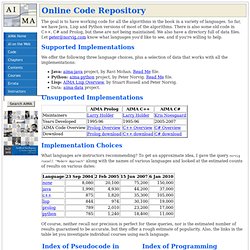
So far, we have Java, Lisp and Python versions of most of the algorithms. There is also some old code in C++, C# and Prolog, but these are not being maintained. We also have a directory full of data files. Let peter@norvig.com know what languages you'd like to see, and if you're willing to help. Aiqus: the ai & cs learning community. Khan Academy.
AI-Class: "Introduction to Artificial Intelligence" Want to learn Artificial Intelligence? Good. Take Stanford's AI Course For Free Online. Not too long ago we told you about how you can access the course materials for Stanford University's introduction to computer science course.
If you're looking for something a bit more advanced, Stanford will offer its artificial intelligence class online for free this fall. It will run from Sept 26 - Dec 16. Online enrollment ends Sept 10. The course will be taught by Sebastian Thrun and Peter Norvig. The course will include online lectures by the two, and according to the course website both professors will be available for online discussions. Thrun is a Research Professor of Computer Science at Stanford, a Google Fellow, a member of the National Academy of Engineering and the German Academy of Sciences. Norvig is Director of Research at Google, and the co-author of the course's primary text Artificial Intelligence: A Modern Approach.
DARPA Grand Challenge (2005) The second driverless car competition of the DARPA Grand Challenge was a 212 km (132 mi) off-road course that began at 6:40am on October 8, 2005, near the California/Nevada state line.
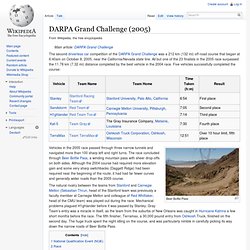
All but one of the 23 finalists in the 2005 race surpassed the 11.78 km (7.32 mi) distance completed by the best vehicle in the 2004 race. Five vehicles successfully completed the course: Beer Bottle Pass Vehicles in the 2005 race passed through three narrow tunnels and navigated more than 100 sharp left and right turns. The race concluded through Beer Bottle Pass, a winding mountain pass with sheer drop-offs on both sides.
The natural rivalry between the teams from Stanford and Carnegie Mellon (Sebastian Thrun, head of the Stanford team was previously a faculty member at Carnegie Mellon and colleague of Red Whittaker, head of the CMU team) was played out during the race. Of the original 195 applicants, initially 40 teams were selected to participate in the National Qualification Event (NQE). Artificial Intelligence: A Modern Approach. Free Classes. Awesome Instructors. Inspiring Community. When does the course begin?
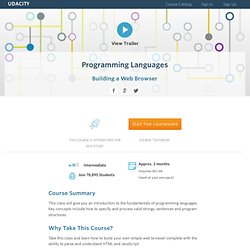
This class is self paced. You can begin whenever you like and then follow your own pace. It’s a good idea to set goals for yourself to make sure you stick with the course. How long will the course be available? Free Classes. Awesome Instructors. Inspiring Community. Udacity - Free Classes. Awesome Instructors. Inspiring Community. Intro to AI - Introduction to Artificial Intelligence - Oct-Dec 2011. Knowitvideos. You (YOU!) Can Take Stanford's 'Intro to AI' Course Next Quarter, For Free. Stanford has been offering portions of its robotics coursework online for a few years now, but professors Sebastian Thrun and Peter Norvig are kicking things up a notch (okay, lots of notches) with next semester's CS221: Introduction to Artificial Intelligence.
For the first time, you can take this course, along with several hundred Stanford undergrads, without having to fill out an application, pay tuition, or live in a dorm. This is more than just downloading materials and following along with a live stream; you're actually going to have to do all the same work as the Stanford students. There's a book you'll need to get. There will be at least 10 hours per week of studying, along with weekly graded homework assignments. To "learn AI" First learn basic mathematics.
I keep getting asked this question and I keep saying the same thing - to three people in the last week, for e.g, two of whom were working through (or planning to work through) AIMA - so I thought I'd put this down here (and point anyone who asks the same question to this entry in the future). Learning AI (or any deep comp.sci for that matter) is not like learning J2EE or ruby "dsl"s or whatever the fad du jour in the enterprise software world is - read a few chapters of the latest bestselling "pragmatic" book, write some crappy web site and hey presto you are the expert.
"Real" comp sci doesn't quite work like that. Artificial Intelligence. Defining Artificial Intelligence The phrase “Artificial Intelligence” was first coined by John McCarthy four decades ago.
One representative definition is pivoted around comparing intelligent machines with human beings. Another definition is concerned with the performance of machines which historically have been judged to lie within the domain of intelligence. Yet none of these definitions have been universally accepted, probably because the reference of the word “intelligence” which is an immeasurable quantity. A better definition of artificial intelligence, and probably the most accurate would be: An artificial system capable of planning and executing the right task at the right time rationally. Artificial Intelligence Depot. Open Source Project Aims to Create Human Level Artificial Intelligence. The Short: Researches across the globe are making daily advances towards the development of human level artificial intelligence, but sadly the algorithms and the software that represent these advances often remain hidden within researcher’s computer labs, out of reach for others to review and build upon.
Enter OpenCog, an entire website dedicated to the development and distribution of artificial intelligence tools, software, and resources that are open source and freely available for anyone to use and modify. Opencog’s ultimate goal is to develop true human level artificial intelligence, but even if Opencog fails to achieve this most ambitious of goals the project still seems poised to bring many other significant benefits to the AI community. Opencog was only recently launched in 2008 and at present appears to have a small following. The Long: Opencog is led by prominent AI scientist Ben Goertzel who will be presenting the opencog project at the Singularity Summit 2008. Python - pythoncad - [Chicago] An open source AI research project. Api - Open Source AI Bot interfaces. Open Source AI Code for Mod Developers? Open source artificial intelligence project.
SparkleShare – Un clone de Dropbox open source qui fonctionne ! I'm building open-source AI server for smarter-than-Human collective intuition - The Bay Area Collective Intelligence Meetup Group (Hayward, CA. Open Source AI projects. Open-Source A.I. Prof. Sebastian Thrun Leaves Stanford, Launches Startup "Udacity" Sebastian Thurn by Jurvetson via Flickr under CreativeCommons Stanford University professor Sebastian Thrun is giving up his job at Stanford to start Udacity – an online educational venture. The first two free courses from that site are “Building a Search Engine” and “Programming a Robotic Car.” His departure from Stanford, however, indicates a serious clash between Thurn and his rogue cohorts and the administration at Stanford.
Thrun explained on his homepage (which appears to be closed by Stanford University now): One of the most amazing things I’ve ever done in my life is to teach a class to 160,000 students. How to start working on opensource ai projects? I'm not sure if you mean infrastructure or an application? For infrastructure here's one example: I think the typical progression is: Join mailing lists. Strong AI (open source) - Devmaster. Hi’ there… Anyone with an interest in AI and knows C++ ?? The basic concept in the “game” we are constructing is as follows: You have an aquarium filled with 3 types of insects. Alicebot. Software. By Robert L. Akers, Ion Bica, Elaine Kant, Curt Randall, and Robert L. Young. AIPARTS.ORG. Linux day 2011 - Alternative open source ai programmi commerciali. OpenAi - - Creating the standard for Artificial Intelligence.
Building better minds together. Video: Goertzel presents open-source AI engine at AGI-11 conference. Cool open source ai projects. Archive for the ‘cool open source ai projects’ Category DeepBeliefSDK This is very cool, iOS video image recognition. I am totally convinced that deep learning approaches to hard AI are going to change our world, especially when they’re running on cheap networked devices scattered everywhere. I’m a believer because I’ve seen how good the results can be on image recognition, but I understand why so many experienced engineers are skeptical. It sounds too good to be true, and we’ve all been let down by AI promises in the past.That’s why I’ve decided to release DeepBeliefSDK, an iOS version of the deep learning approach that has taken the computer vision world by storm.
GitHub, DeepBeliefSDK. Open Source AI. Open source ai.