
UC Irvine Feature: Math tumor - Aurora. Mathematics reveals genetic pattern of tumor growth - Aurora. Using mathematical theory, UC Irvine scientists have shed light on one of cancer’s most troubling puzzles -- how cancer cells can alter their own genetic makeup to accelerate tumor growth.

The discovery shows for the first time why this change occurs, providing insight into how cancerous tumors thrive and a potential foundation for future cancer treatments. UCI mathematicians Natalia Komarova, Alexander Sadovsky and Frederic Wan looked at cancer from the point of view of a tumor and asked: What can a tumor do to optimize its own growth" They focused on the phenomenon of genetic instability, a common feature of cancer in which cells mutate at an abnormally fast rate. These mutations can cause cancer cells to grow, or they can cause the cells to die.
The scientists found that cancerous tumors grow best when they are very unstable in early stages of development and become stable in later stages. The study appeared this week in the Royal Society journal Interface. Mathematical models of tumor growth - WebFerret Results - Aurora. How Normal Cells Become Brain Cancers. Brain tumor specimens taken from neurosurgery cases at the University of California, San Francisco (UCSF) Medical Center has given scientists a new window on the transformation that occurs as healthy brain cells begin to form tumors.
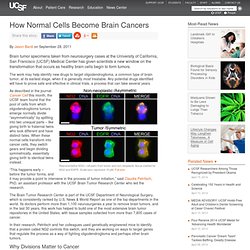
The work may help identify new drugs to target oligodendroglioma, a common type of brain tumor, at its earliest stage, when it is generally most treatable. Any potential drugs identified will have to prove safe and effective in clinical trials, a process that can take several years. Representative NG2+ cell pairs from tumor and non-neoplastic tissue stained for NG2 and EGFR. Scale bars represent 10 μM.
Full size As described in the journal Cancer Cell this month, the UCSF team found that the pool of cells from which oligodendroglioma tumors emerge normally divide “asymmetrically” by splitting into two unequal parts – like giving birth to fraternal twins who look different and have distinct fates. Claudia Petritsch, PhD Figure: C.Petritsch/UCSF. Rx: Sand piles and Cancer - Aurora. Physica A: Statistical Mechanics and its Applications - 3-D in vivo brain tumor geometry study by scaling analysis - Aurora.
Breast cancer tumor growth estimated through mammography screening data - StumbleUpon - Aurora. Setting: data In 1995 the Norwegian Government initiated an organized population-based service screening program [10], in which mammography results and interval cancer cases are carefully registered by the Cancer Registry of Norway. The Norwegian Breast Cancer Screening Program (NBCSP) originally included four counties. Other counties were subsequently included, and by 2004 the screening program achieved nationwide coverage. All women between 50 and 69 years of age receive a written invitation biannually, and two-view mammograms from participating women are independently evaluated by two readers.
A high-quality population-based Cancer Registry and a unique personal identity number for each inhabitant in the country enables close follow-up over time [11], and the possibility to link data from several sources (Figure 1). Figure 1. The present study includes screening data from 1995 to 2002. Figure 2. Growth model specification Figure 3. Screening test sensitivity model specification.