
Meditation: The Science of the Inner. Osho Meditation Techniques. If you want to live a more fulfilled life, first you will want to know your potential, who you really are.

Meditation is the route to that knowing. It is the methodology of the science of awareness. The beauty of the inner science is that it enables whoever wants to explore and to experiment within, to do so alone. This eliminates dependence on an outer authority, the need to be affiliated with any organization and the obligation to accept a certain ideology. Once you understand the steps, you walk the walk in your own, individual way. Many meditative techniques require one to sit still and silent. Osho Active Meditations have been scientifically designed by Osho over a period of time to enable us to consciously express and experience repressed feelings and emotions, and learn the knack of watching our habitual patterns in a new way.
But what is meditation exactly? Resources for Spiritual Journeys. The Tree of Contemplative Practices. The Tree illustrates some of the contemplative practices currently in use in secular organizational and academic settings.
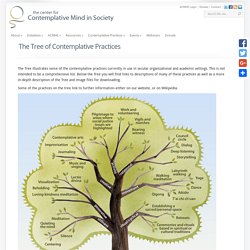
This is not intended to be a comprehensive list. Below the Tree you will find links to descriptions of many of these practices as well as a more in-depth description of the Tree and image files for downloading. Some of the practices on the tree link to further information–either on our website, or on Wikipedia. © The Center for Contemplative Mind in Society Concept & design by Maia Duerr; illustration by Carrie Bergman Understanding the Tree On the Tree of Contemplative Practices, the roots symbolize the two intentions that are the foundation of all contemplative practices.
The branches represent different groupings of practices. Because this illustration cannot possibly include all contemplative practices, we offer a free download of a blank Tree that you can customize to include your own practices. Downloading and Reprinting the Tree For printing: The Habit Change Cheatsheet: 29 Ways to Successfully Ingrain a Behavior. We are what we repeatedly do.
Excellence, then, is not an act, but a habit. – Aristotle Our daily lives are often a series of habits played out through the day, a trammeled existence fettered by the slow accretion of our previous actions. By Leo Babauta But habits can be changed, as difficult as that may seem sometimes. I’m a living example: in tiny, almost infinitesimal steps, I’ve changed a laundry list of habits. It’s possible. And while I’ve written about habit change many times over the course of the life of Zen Habits, today I thought I’d put the best tips all together in one cheatsheet, for those new to the blog and for those who could use the reminders. Keep it simple Habit change is not that complicated. The simple steps of habit change: