
Thoriumenergy.com - Home. Liquid Thorium Fuel Gets a Start. Oct October 6, 2010 | 7 Comments Brian Wang at NextBigFuture found the news of a press conference at the Japanese organization Keidanren, an industry group with big name members such as Toyota, Toshiba and Hitachi.
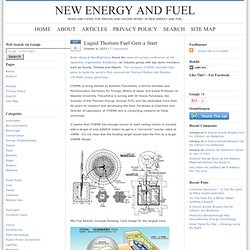
The company IThEMS unveiled their plans to build the world’s first commercial Thorium Molten-Salt Reactor (Th-MSR) power generator. IThEMS is being started by Keishiro Fukushima, a former Senator and Parliamentary Secretary for Foreign Affairs of Japan and Guest Professor of Waseda University. Fukushima is joining with Dr. It seems that IThEMS has enough money to start raising money in earnest with a target of only $300US million to get to a ‘micromini’ reactor rated at 10MW. Mini Fuji Reactor Concept Drawing. Small Fuji Reactor Installation Graphic.
The major feature to thorium fuel in a thorium molten liquid salt form is the safety as Japan is extremely conscious of the earthquake effects on uranium fueled reactor cores. Is Thorium the Biggest Energy Breakthrough Since Fire? Possibly. TopStocks > ILUKA RESOURCES LIMITED > ILU's thorium reserves. Thorium pushed as uranium alternative 07 Nov, 2011 03:00 AM A SCIENTIFIC movement to promote thorium as a nuclear fuel, due to its abundance and improved safety, is developing around the world and Australia could lead the way.

The Sydney scientist Reza Hashemi-Nezhad has argued for more than a decade for the benefits of thorium when used in an accelerator-driven nuclear reactor that operates at subcritical conditions. ''You cannot have an accident similar to Chernobyl,'' Dr Hashemi-Nezhad, the director of the Institute of Nuclear Science at the University of Sydney, said. ''It does not produce weapon-grade materials.
With the world's largest reserves of the radioactive mineral, Australia could be a leader in developing and adopting the technology. ''It is completely proven and feasible,'' Dr Hashemi-Nezhad said. In September, a not-for-profit group, the Weinberg Foundation, was launched in Britain to advocate for thorium nuclear energy. 690398.pdf (application/pdf Object) Thorium. (Updated March 2014) Thorium is more abundant in nature than uranium.It is fertile rather than fissile, and can only be used as a fuel in conjunction with a fissile material such as recycled plutonium.Thorium fuels can breed fissile uranium-233 to be used in various kinds of nuclear reactors.Molten salt reactors are well suited to thorium fuel, as normal fuel fabrication is avoided.
The use of thorium as a new primary energy source has been a tantalizing prospect for many years. Extracting its latent energy value in a cost-effective manner remains a challenge, and will require considerable R&D investment. This is occurring preeminently in China, with modest US support. Nature and sources of thorium Thorium is a naturally-occurring, slightly radioactive metal discovered in 1828 by the Swedish chemist Jons Jakob Berzelius, who named it after Thor, the Norse god of thunder.
New age nuclear. Credit: Justin Randall What if we could build a nuclear reactor that offered no possibility of a meltdown, generated its power inexpensively, created no weapons-grade by-products, and burnt up existing high-level waste as well as old nuclear weapon stockpiles?
And what if the waste produced by such a reactor was radioactive for a mere few hundred years rather than tens of thousands? It may sound too good to be true, but such a reactor is indeed possible, and a number of teams around the world are now working to make it a reality. What makes this incredible reactor so different is its fuel source: thorium. Named after Thor, the warlike Norse god of thunder, thorium could ironically prove a potent instrument of peace as well as a tool to soothe the world’s changing climate.
But nuclear power comes with its own challenges. A thorium reactor is different. That may not sound like much, but small changes in the global average can mask more dramatic localised disruptions in climate. Thorium. Thorium is a naturally occurring radioactive chemical element with the symbol Th and atomic number 90.
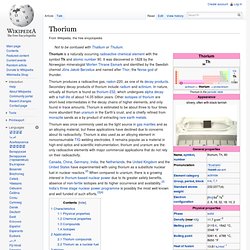
It was discovered in 1828 by the Norwegian mineralogist Morten Thrane Esmark and identified by the Swedish chemist Jöns Jakob Berzelius and named after Thor, the Norse god of thunder.