
Representing-decimals-in-different-ways.pdf. Map.mathshell.org/materials/download.php?fileid=1360. Fill 'Er Up. Prior to teaching this lesson, familiarize yourself with the Cubes applet.

Introduce the lesson by holding up a familiar household prism such as a clear plastic storage container. Use the object to review vocabulary including rectangular prism, length, width, height, surface area, and volume. Ask students to identify the three linear measurements: length, width, and height. Start by labeling the bottom face and its length and width.
The height is the perpendicular distance between the top and bottom faces. To illustrate the concept of volume, drop some inch or centimeter cubes into the box. Distribute the Fill 'Er Up activity sheet to each student. Distribute two sheets of paper and some centimeter cubes to each student. Discuss with students how the volume can be determined without completely filling the prism with cubes. Summarize key concepts of the lesson at the end of class. Voriginal = lwh Vnew = (2l)(2w)(2h) = 8lwh Showcase a well-made origami model. Shape Up. The following activity ideas are written as either teacher-centered or small group/pair activities.

All activities could be adapted to be either type. Depending on student knowledge, there are certainly sections that can be repeated and others than can be skipped. You can choose a flexible path through the instructional plan to best meet the needs of your students. Students are to work in pairs or small groups. In some cases, the pair will need to have 2 sets of shapes. Begin by modeling at least one activity for the class.
While the games are being played, keep a word wall of geometry terms that will grow throughout the activities that students participate in. Yes and No Choose one characteristic that you will use to classify all of the shapes. Here is an example: The characteristic used to classify shapes is: At least one angle is a reflex angle Students may describe the shape using its characteristics, such as "All the Yes shapes have corners that go in. " Guess What At Their Desks. Lesson Plans - Mathematics - 5th Grade. Place Value Strategy. Overview - About the Assessment - Math Reasoning Inventory. MRI is an online formative assessment tool designed to make teachers’ classroom instruction more effective.
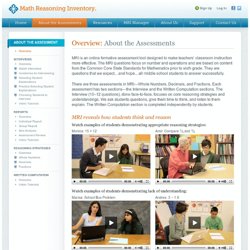
The MRI questions focus on number and operations and are based on content from the Common Core State Standards for Mathematics prior to sixth grade. They are questions that we expect…and hope…all middle school students to answer successfully. There are three assessments in MRI—Whole Numbers, Decimals, and Fractions. Each assessment has two sections—the Interview and the Written Computation sections. The Interview (10–12 questions), done face-to-face, focuses on core reasoning strategies and understandings.
Watch examples of students demonstrating appropriate reasoning strategies: Watch examples of students demonstrating lack of understanding: Watch an example of a student who uses a procedure inappropriately:
Wp/wp-content/uploads/flipbooks/7th_FlipBookEdited21.pdf. Blackline Masters. Order of operations. WeAreTeachers - Get Lesson Plans, Teacher Grants, Teaching Resources and More. Place Value. Math Common Core. Technology. Www.multiplication.com. Rectangle Multiplication. National Library of Virtual Manipulatives. Teacher resources.