The Fungi of Southern England. Learn. There are no truths, only stories.
-Simon Ortiz, Acoma Pueblo poet You and I are among the more than 70 million Americans who have used cannabis — and possibly among the more than ten million who use it regularly. We know that people smoke marijuana not because they are driven by uncontrollable “Reefer Madness” craving, as some propaganda would lead us to believe, but because they have learned its value from experience. Yet almost all of the research, writing, political activity, and legislation devoted to marijuana has been concerned only with the question of whether it is harmful and how much harm it does. The only exception is the growing medical marijuana movement, but as encouraging as that movement is, it represents only one category of marijuana use. Accounts judged to be useful will be posted on this web site as they are received. A little about me. I have posted as the first essay on the web site “A Cannabis Odyssey”, an essay about my personal involvement with this issue.
Anadenanthera. Anadenanthera is a genus of South American trees in the Legume family, Fabaceae.
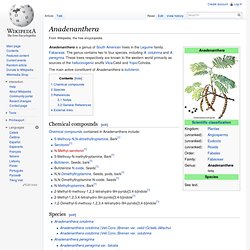
The genus contains two to four species, including A. colubrina and A. peregrina. These trees respectively are known to the western world primarily as sources of the hallucinogenic snuffs Vilca/Cebil and Yopo/Cohoba. The main active constituent of Anadenanthera is bufotenin. Chemical compounds[edit] Chemical compounds contained in Anadenanthera include: Ipomoea violacea. Ipomoea violacea is a perennial species of Ipomoea that occurs throughout the world by the exception of European continent. It is most commonly called 'Beach Moonflower' or 'Sea Moonflower' as the flowers open at night.[1] Description[edit] A complete description is stored on the website efloras.org : "Plants perennial, woody, twining, glabrous. Stems to 5 m, often longitudinally wrinkled.
Petiole 3.5-11 cm; leaf blade circular or ovate, 5-16 X 5-14 cm, base deeply cordate; lobes rounded or rarely angular, apex acuminate, mucronulate; lateral veins 7 or 8 pairs. Comparative taxonomies[edit] As often mistaken with Ipomoea tricolor, one must compare the taxonomy of the two plants. Ipomoea violacea:[4] Genus: Ipomoea Subgenus: Eriospermum Section: Erpipomoea Ipomoea tricolor:[5] Subgenus: Quamoclit Section: Tricolor LSA presence[edit] References[edit]