
Street View – Google Maps. City plan diagrams. Exhaustive Images : Surveillance, Sovereignty, and Subjectivity in Google Maps Street View (Gabrielle Moser) Further expanding the already large class of Foucauldian apparatuses, I shall call an apparatus literally anything that has in some way the capacity to capture, orient, determine, intercept, model, control, or secure the gestures, behaviors, opinions, or discourses of living beings.

—Giorgio Agamben For a technology that is purportedly meant to aid in the description and representation of geographic space, the Google Maps Street View program manages to capture a remarkable number of human subjects. Employing an automated, nine-lensed camera, mounted on vehicles ranging from a large utility van to, more recently, a modified tricycle, Street View creates a 360° horizontal panorama of public streets, paths, and hiking trails in more than a dozen countries, all accessible through an interactive Web site. The modern biopower that Street View exemplifies is also marked by the characteristics of global capitalism.
Digital Citizens Nine Eyes Are Better than Two. Mapping urban complexity. Erik Johansson: Impossible photography. Jerry N. Uelsmann. Interviews « Jerry Uelsmann News. Simulacrum. A simulacrum (plural: simulacra from Latin: simulacrum, which means "likeness, similarity"), is a representation or imitation of a person or thing.[1] The word was first recorded in the English language in the late 16th century, used to describe a representation, such as a statue or a painting, especially of a god.
By the late 19th century, it had gathered a secondary association of inferiority: an image without the substance or qualities of the original.[2] Philosopher Fredric Jameson offers photorealism as an example of artistic simulacrum, where a painting is sometimes created by copying a photograph that is itself a copy of the real.[3] Other art forms that play with simulacra include trompe-l'œil,[4] pop art, Italian neorealism, and French New Wave.[3] Philosophy[edit] Literature, film, television, and music[edit] Artificial beings[edit] Simulacra often appear in speculative fiction. Simulated environments[edit] Film[edit] TV series[edit] Music[edit] Philip K. Synecdoche, New York. Synecdoche, New York is a 2008 American postmodern[3] drama film written and directed by Charlie Kaufman, and starring Philip Seymour Hoffman.
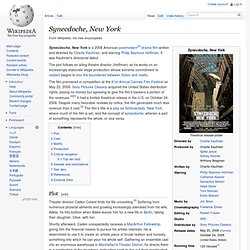
It was Kaufman's directorial debut. The film premiered in competition at the 61st Annual Cannes Film Festival on May 23, 2008. Sony Pictures Classics acquired the United States distribution rights, paying no money but agreeing to give the film's backers a portion of the revenues.[4][5] It had a limited theatrical release in the U.S. on October 24, 2008. Despite many favorable reviews by critics, the film generated much less revenue than it cost.[2] The film's title is a play on Schenectady, New York, where much of the film is set, and the concept of synecdoche, wherein a part of something represents the whole, or vice versa.
Plot[edit] Shortly afterward, Caden unexpectedly receives a MacArthur Fellowship, giving him the financial means to pursue his artistic interests. Cast[edit] Motifs[edit] The burning house Jungian psychology References to delusion.