
Projects. As of July 1, 2013 ThinkQuest has been discontinued.
We would like to thank everyone for being a part of the ThinkQuest global community: Students - For your limitless creativity and innovation, which inspires us all. Teachers - For your passion in guiding students on their quest. Partners - For your unwavering support and evangelism. Parents - For supporting the use of technology not only as an instrument of learning, but as a means of creating knowledge. Q%A Panama Canal (Great Resource) Who was the 1st Chief Engineer during the construction under US administration?

John F. Wallace was the first Chief Engineer of the Panama Canal, during the U.S. construction period. Wallace directed all the works until 1905, when he was replaced by John F. Stevens. Who completed the construction of the Panama Canal? Colonel George W. How many employees were there during the construction of the Panama Canal? Between 1904 and 1913, a total of 56,307 persons were employed during the construction of the Panama Canal; 11,873 were European; 31,071 were from the West Indies; 11,000 were from the United States; and there were 69 unclassified. How many people died during the French and U.S. construction of the Panama Canal? According to hospital records, 5,609 died of diseases and accidents during the U.S. construction period. Chronicling America - The Library of Congress. Prove It!: A Citation Scavenger Hunt. Lesson Plan Preview “Prove it!”

Is a common phrase heard from many teachers to their students during the research and writing process. Having little or no support for specific assertions in a research paper can be troublesome. A citation scavenger hunt is a fun and challenging way for students to practice finding citations that support details about the characters, plot or themes from a text. Panama Canal. Theodore Roosevelt's Corollary to the Monroe Doctrine (1905) In his annual messages to Congress in 1904 and 1905, President Theodore Roosevelt expanded the Monroe Doctrine.
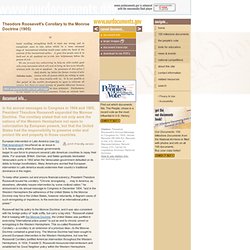
The corollary stated that not only were the nations of the Western Hemisphere not open to colonization by European powers, but that the United States had the responsibility to preserve order and protect life and property in those countries. European intervention in Latin America (see the Platt Amendment) resurfaced as an issue in U.S. foreign policy when European governments began to use force to pressure several Latin American countries to repay their debts. For example, British, German, and Italian gunboats blockaded Venezuela’s ports in 1902 when the Venezuelan government defaulted on its debts to foreign bondholders. Many Americans worried that European intervention in Latin America would undermine their country’s traditional dominance in the region. To keep other powers out and ensure financial solvency, President Theodore Roosevelt issued his corollary.
WWI.
History/Education/Technology. 50 Great Sites For Social Studies Teachers (Part Deux) U.S. History. Interesting Ideas and Inventions. Morning Meeting Videos. Invention and Innovation. Teaching Resources. Teaching Strategies. Common Core Standards. Educational Technology. Flipped Classroom. 99 Mind Mapping Resources, Tools, and Tips. So, there you are staring at that black sheet of paper again.

Or perhaps it's a black Word document on your computer screen. Whichever it may be, it's obvious you're about to take notes for that big essay assignment or group project, and you're not too excited about getting started! That's where a different kind of note taking comes in to play, one that is actually fun to do and will also help you to understand your notes better. It's a technique called mind mapping, and is based around a strong visual method of taking notes. Whether your using colorful markers and paper or using state-of-the-art computer software, you'll find using mind maps are a much more interesting way to take notes than you ever have in the past! Free Software Free Mind - the premier java-based mind mapping software known for its quick, one-click "fold/unfold" and "follow link" operations.
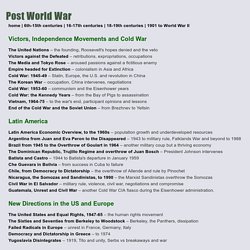
Wisemapping - "Visual Thinking Evolution", offering free web based mind maps you can share anywhere on the web. Resources Books. 1945 to 21st Century. Home | 6th-15th centuries | 16-17th centuries | 18-19th centuries | 1901 to World War II Victors, Independence Movements and Cold War The United Nations – the founding, Roosevelt's hopes denied and the veto Victors against the Defeated – retributions, expropriations, occupations The Media and Tokyo Rose – aroused passions against a fictitious enemy Empire headed for Extinction – colonialism in Asia and Africa Cold War: 1945-49 – Stalin, Europe, the U.S. and revolution in China The Korean War – occupation, China intervenes, negotiations Cold War: 1953-60 – communism and the Eisenhower years.
Presidential Speech Archive - Miller Center of Public Affairs. P.O.D. CLASS.