
A future full of robots. A future where robots are as common as cars – and cheaper – is on the way.
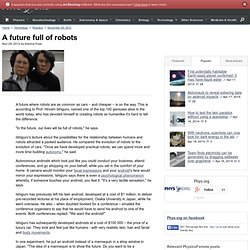
This is according to Prof. Hiroshi Ishiguro, named one of the top 100 geniuses alive in the world today, who has devoted himself to creating robots so humanlike it's hard to tell the difference. "In the future, our lives will be full of robots," he says. Ishiguro's lecture about the possibilities for the relationship between humans and robots attracted a packed audience. He compared the evolution of robots to the evolution of cars. Autonomous androids which look just like you could conduct your business, attend conferences, and go shopping on your behalf, while you sat in the comfort of your home. Ishiguro has previously left his twin android, developed at a cost of $1 million, to deliver pre-recorded lectures at his place of employment, Osaka University in Japan, while he went overseas.
To Launch Human-Like Robot to Join Space Station Crew. NASA to Launch Human-Like Robot to Join Space Station Crew NASA will launch the first human-like robot to space later this year to become a permanent resident of the International Space Station.
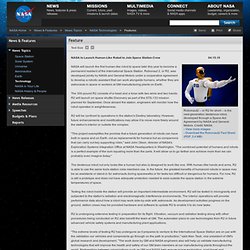
Robonaut 2, or R2, was developed jointly by NASA and General Motors under a cooperative agreement to develop a robotic assistant that can work alongside humans, whether they are astronauts in space or workers at GM manufacturing plants on Earth. The 300-pound R2 consists of a head and a torso with two arms and two hands. R2 will launch on space shuttle Discovery as part of the STS-133 mission planned for September. Once aboard the station, engineers will monitor how the robot operates in weightlessness. R2 will be confined to operations in the station's Destiny laboratory. The dexterous robot not only looks like a human but also is designed to work like one. Should We Ban ‘Killer Robots’? Human Rights Group Thinks So. As if deploying drones — unmanned aerial vehicles — on the battlefield wasn’t controversial enough, here’s an even more disturbing question: Should we allow weapon-wielding robots that can “think” for themselves to attack people?
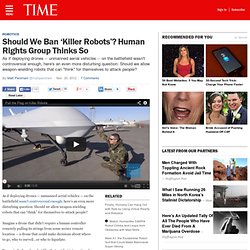
Imagine a drone that didn’t require a human controller remotely pulling its strings from some secure remote location — a drone that could make decisions about where to go, who to surveil…or who to liquidate. No one’s deployed a robot like that yet, but international human rights advocacy group Human Rights Watch sees it as an issue we need to deal with before the genie’s out of the bottle.
The group is calling for a preemptive ban on all such devices “because of the danger they pose to civilians in armed conflict.” They’ve even drafted a 50-page report titled “Losing Humanity: The Case Against Killer Robots,”which lays out its case against autonomous weaponized machines. What does HRW recommend we do? Hiroshi Ishiguro: The Man Who Made a Copy of Himself. Photo: Makoto Ishida Hiroshi Ishiguro, a roboticist at Osaka University, in Japan, has, as you might expect, built many robots.
But his latest aren’t run-of-the-mill automatons. Ishiguro’s recent creations look like normal people. One is an android version of a middle-aged family man—himself. Ishiguro constructed his mechanical doppelgänger using silicone rubber, pneumatic actuators, powerful electronics, and hair from his own scalp. Ishiguro controls this robot remotely, through his computer, using a microphone to capture his voice and a camera to track his face and head movements.
It’s the perfect tool for Ishiguro’s field of research: human-robot interaction, which is as much a study of people as it is of robots. ”My research question is to know what is a human,” he tells me between spoonfuls of black sesame ice cream at an Osaka diner. ”I use very humanlike robots as test beds for my hypotheses”—hypotheses about human nature, intelligence, and behavior.