
Identity SHORT FILM (Award Winning Inspirational Short) Video that will change your life. I have no words left. Creating a Safe and Respectful Environment in Our Nation's Classrooms Training Toolkit. Jump to navigation Search form Creating a Safe and Respectful Environment in Our Nation's Classrooms Training Toolkit This training toolkit is made up of two modules that address bullying in classrooms.
Specifically, it is designed for trainers to assist teachers in cultivating meaningful relationships with students while creating a positive climate in the classroom. Safesupportivelearning.ed.gov/sites/default/files/sssta/20121108_20120928ClsrmMod1WorkshopOverviewFINAL.pdf. Media Education Foundation. CRIME in Esl/Efl: Crime Scene-Do not enter. CLICK TO VIEW MORE -SOURCE: National Crime Prevention Council (Singapore) VIDEO SOURCE: IS IT LOVE?
(SOURCE: osocio.org) Mourning victims of domestic violence in Costa Rica (SOURCE: osocio.org) CLICK TO LEARN MORE OCEANKING97 STOPS CYBERBULLIES (SOURCE: hudsonhouston.com) CLICK TO READ MORE cyber-bullying (DOWNLOAD)PowerPoint presentation Click on ICT: General Resources(SOURCE: primaryresources.co.uk) Play Scripts for High Schools and Middle Schools - Complete List [page 4 of 14] - Theatrefolk. The Hunger Games: Propaganda and Persuasion: Evaluation. Crazy For Friends - Scripts. Catalyst: Archaeology & History Stories - ABC TV Science. Foreign Correspondent. Surrogacy is big business in India.
It’s now worth hundreds of millions of dollars a year – some estimate more than a billion - fuelled by tax breaks for medical tourism, childless couples around the world trying to start a family and young Indian women desperate for a pay day that could set their families up for life. But are ethics and adequate regulation being dismissed in the rush to supply thousands of foreigners and rich Indians with babies? We follow the paths of two Australian couples navigating India’s booming baby-making industry, paying and doing what it takes to succeed and bring a baby home. As we’ll see, results seldom play according to hopes and dreams. The outrageous glitter and stunning promise of Dubai beckoned so Australian couple Marcus & Julie Lee packed their bags and set off for the booming Middle Eastern city to chase their dreams.
READING. GRAMMAR. WRITING. Student Self Evaluation. I was working on a self evaluation sheet to give to students, and thought that I might share it here with everyone.
The purpose of this sheet is to help students notice different elements in their learning. It's focus is on the 4 macro-skills, grammar, vocabulary, and conversation strategies.The main parts to the worksheet are as follows:(i) Orientation: Marks the lesson completed and the grammar focus (you can change the focus if you like).
Technology Integration Matrix. Visualizing Technology Integration « The Trouble With Online Education. Transforming Teaching in the Digital Age: A Blueprint (GeekDad Weekly Rewind) Literacy and numeracy are important. We all know our children need to be able to read and write and add up, but increasingly as the pace of change in our world increases what were once seen as fundamental aspects of education need to be challenged. And, thankfully, there are people out there not just challenging our assumptions, but intelligently going about the business of rethinking what our children’s education needs to look like in the 21st century. The Digital Age Teacher Preparation Council, established by the Joan Ganz Cooney Center at Sesame Workshop and the Stanford Center for Opportunity Policy in Education, with support from the Joyce Foundation, released today the report Take a Giant Step, detailing a multi-sector action plan to enhance teacher education and a higher quality, 21st-century approach to the learning and healthy development of children in preschool and the primary grades.
Digital tools and infrastructure are not enough. I recommend that we as parents engage. Discovery Education Web2012 : Web 2.0 Tools. Pearltree - Ben's Guide to US Government - great resource for K12. Pearltrees is a great, free site I wrote about in January that lets you organize web content in a visual pattern.
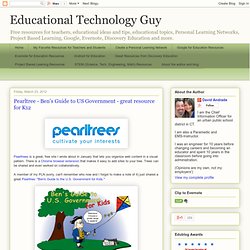
There is a Chrome browser extension that makes it easy to add sites to your tree. Trees can be shared and even worked on collaboratively. The resources are sorted by grades: K-2, 3-5, 6-8, 9-12 and there is a page about Ben and a Parent and Educator section. Each section has information, links and resources about the US Government. This is a great resource for anyone teaching, or learning, about the US Government and how it works.
ESL games and activities. Drama. TED ED. Language Blogs. The Thinking Classroom: Ways of Thinking. Effective thinking-centered instruction aims to achieve two educational objectives: To cultivate the active use of knowledge, and To help students become self-regulated learners.
Toward that end, this section of The Thinking Classroom highlights four thinking-centered approaches for infusing high-level thinking instruction into your regular curriculum. The Ways of Teaching Thinking region features a preview and description of each of the approaches. Why These Four Approaches? The four approaches to teaching thinking represent some of the research and products of the Harvard's Cognitive Skills Group. But more important, the four approaches together broadly attend to the core components of the instructional enterprise - from curriculum design, to implementation, to assessment.