
How to Code HTML Email Newsletters. This article was first published in 2006, then re-edited in 2011 — and it’s still one of our most popular posts.
If you’re keen to learn more about styling HTML email campaigns, head to our recent post on creating email signatures. HTML email newsletters have come a long way since this article was first published back in 2006. HTML email is still a very successful communications medium for both publishers and readers. Publishers can track rates for email opens, forwards, and clickthroughs, and thereby can measure reader interest in products and topics; readers are presented with information that’s laid out like a web page, in a way that’s more visually appealing, and much easier to scan and navigate, than plain text email. In some ways, coding HTML email has become easier — several email software providers, such as Google Mail, have improved their support for CSS.
Case study: reader fatigue in email newsletters. Published by Elizabeth Yin By Jennifer and Elizabeth A couple weeks ago, we received this email: Hi Jennifer, I have a question.

Our open rate keeps going down and I have no clue what’s going on there. Thank you, [Newsletter publisher name] We generated this graph to get them some answers. This graph breaks their subscribers into cohorts by the month they subscribed. As you can see, the overall open rate is indeed decreasing. Over time, however, they don’t open as often. Older customer acquisition channels are more engaged Almost all the cohorts in this case mimic a similar pattern regardless of their starting and ending open rates. Moreover, the older subscribers on this list seem to be much more engaged. We recommended taking a closer look at August-October customer acquisition channels to see if there was something unique about their marketing then that is different now.
Cheaper customer acquisition channels vs. open rate? On the outset, this seems like a win for them.
Writing. Why I am super-excited about Email Marketing in... - Retail Analytics. UPDATE ( July 3rd, 2013 ) - ht to Tim SchulzTim sent this to me today - It looks like this post was on track with the data that is coming out: Source Why I am super bullish on Email Marketing: I have received a lot of pushback, criticism, and flaming flack for being super bullish on email marketing for 2013 - email is dying they tell me & I 'don't get it' they say...

It's a game for young-bucks and you old timers don't know what you're talking about they comment - but here is why I love email: Think of email as the cover to the magazine that used to be delivered via the Post - the visual design drives your to open & read... the same thing here! 1. 2. 3. Make life easy for them Email will be the tool because when you do it right - it's a really valuable experience that you can customize with very little investment in changing the core nature of your application. The appeals were the product of rigorous experimentation by a large team of analysts. When Video Met Email. Here’s a little secret: we love it when new people learn about Wistia by watching one of our videos.
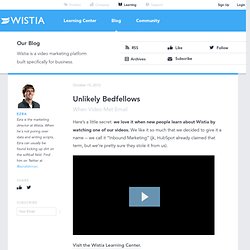
We like it so much that we decided to give it a name -- we call it “Inbound Marketing” (jk, HubSpot already claimed that term, but we’re pretty sure they stole it from us). Visit the Wistia Learning Center. Find more video marketing and production resources. Okay, so it’s not a new idea, but the question is, how can we get great content in front of these new people? We’ve found that the most consistent and reliable way to expand our reach is actually to use email and focus on the people already in our audience. For us, it’s a cyclical process. Email is the best, most direct way to get the sharing process going, and high click-through rates come with consistently good content and fun thumbnails!
See the mechanics video! GMail Rank and the Importance of Good Subject Lines. Google is experimenting with including emails in your search results.

Of course, the emails you see will be personal to you, and won’t be shared with others. The emails will only be the ones that you received via Gmail, and the service is opt-in only. The announcement was made on August 8th, in the Google Official Blog post, Building the search engine of the future, one baby step at a time Chances are that the rankings used to decide which emails to show, and the order of those emails is probably very similar to the importance rankings used to display different colored markers on your emails in Gmail. One of the good things about those importance ranking markers is that if you want, you can search and filter your Gmail emails by them if you want, as well as using other advanced search filters.
There is a company named Mailrank that announced a move of their engineers to Facebook on their homepage and Facebook page in November, and the move was reported in Mashable as well. Abstract.