
Attribution-NonCommercial-ShareAlike 3.0 Unported — CC BY-NC-SA 3.0.
On open educational resources. Image by opensource.com Despite the attempts at single sentence definitions so common in the published literature, “open educational resources” is a highly context-mediated construct.
However, because philanthropic and public funding agencies commonly require grant outputs to be open educational resources, the ability to quickly and clearly categorize a variety of creative works as “open educational resources” or “not open educational resources” has become critical. Many funding agencies and programs that require OER simply require grantees to apply a Creative Commons license to their grant outputs (e.g., the William and Flora Hewlett Foundation, the U. S. Department of Labor, the Washington State Board of Community and Technical Colleges, etc.) in order to meet the “open educational resources” requirement.
POSSE: Professors’ Open Source Summer Experience. [TOS] Announcing the textbook. :) Open*Education: 2011 in review. There is something about a new year that always seems so promising and energizing.
It doesn’t seem like too long ago we were saying thank heavens for 2011, and now it’s time to bring in 2012. Before we close this chapter, let’s take a quick look at the ten most popular articles in the education community for 2011, starting with number ten and counting down. Open Text Book.
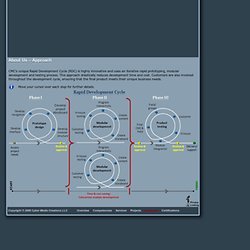
eLearning development approaches, rapid development cycle (RDC), rapid prototyping. This content requires the Adobe Flash Player.
Education. Most people think of their interactions with computer systems to occur via a keyboard, mouse, or touchscreen.
However, humans evolved to interact with thier environment and each other in much more intricate ways. Bridging the gap between the computational systems of the digital world and the natural world is being studied and tested in the Physical Computing course at the State University of New York (SUNY) at Albany. As a professor of the course, we are currently leveraging a variety of open source software and hardware projects to learn about fundamental core concepts with hands-on experiences and implementation of open source tools. On the software side, we use an open-source IDE (Arduino Sketch) and develop 3D printer designs using OpenSCAD. Webcast recap and recording: MIT OpenCourseWare's past and future. Image by opensource.com This year, MIT OpenCourseWare is celebrating its tenth anniversary.
That's one full decade providing open access to more than 2,000 courses with course materials including lecture notes, problem sets, syllabuses, exams, simulations, and the video lectures. In today's webcast, Cecilia d’Oliveira, executive director of OpenCourseWare, shared the history of OpenCourseWare and its vision for the future. "Access alone is not enough" Josh Jarrett, Deputy Director of Postsecondary Success at the Bill and Melinda Gates Foundation. Image credits: Open Education Conference Josh Jarrett, Deputy Director of Postsecondary Success at the Bill and Melinda Gates Foundation, delivered today's keynote at the Open Education Conference with a simple message (but no simple answer): Access alone is not enough to help people realize their dreams.
The Gates Foundation focuses on education because it is still the "primary arbiter of opportunity in this country," he continued. Freer than free, opener than open: The fight for the learning management systems market is heating up (again) Open education resources: Moving from sharing to adopting. Image by opensource.com Educators have been sharing open educational resources (OERs) for over 12 years now.
There are literally tens of thousands of them out there, many structured as collections of course materials known as open courseware (OCW), some structured as complete open courses, some structured as complete open textbooks, and many not really structured at all. The “sharing ball” is rolling. There are more materials that need to be shared, but the eventual sharing of these materials has now become inevitable. What is anything but inevitable is the adoption of any of these open educational resources. While the mainstream of education will finally begin sharing OERs this decade, those leaders who think of themselves as being on the cutting edge of the open education movement need to start walking the walk / becoming living examples / modeling the desired behavior of adopting others’ OERs.
General Service List. The General Service List (GSL) is a list of roughly 2000 words published by Michael West in 1953.[1] The words were selected to represent the most frequent words of English and were taken from a corpus of written English.
The target audience was English language learners and ESL teachers. To maximize the utility of the list, some frequent words that overlapped broadly in meaning with words already on the list were omitted. In the original publication the relative frequencies of various senses of the words were also included. Details[edit] The list is important because a person who knows all the words on the list and their related families would understand approximately 90-95 percent of colloquial speech and 80-85 percent of common written texts.
LIST_LEARN - Resource Linked Word Lists. What a classroom will look like in 10 years. Open Source Physics wins award for online education. Image by opensource.com Open Source Physics is an online curriculum resource, created and edited by a group of college professors, that provides students new ways to understand and predict physical phenomena through computational physics and computer modeling.
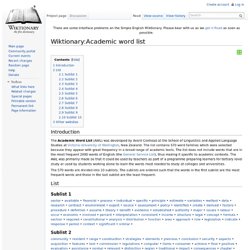
For students who learn best by exploring and doing versus just reading this is an outstanding resource. Open Source Physics came to fruition because these professors felt like there was a gap between what students were learning in the classroom and the skills they needed. Unfortunately, such realizations appear to be consistent within education as a whole. Academic word list - Simple English Wiktionary. Wiktionary:Academic word list From Wiktionary Jump to: navigation , search Introduction The Academic Word List (AWL) was developed by Averil Coxhead at the School of Linguistics and Applied Language Studies at Victoria University of Wellington , New Zealand.
Open source goes to high school. Brigham Young University faculty survey seeks to advance open education through academic libraries. Image by opensource.com Jeff Belliston and Elizabeth Smart from Brigham Young University are working to address the issues facing academic libraries trying to advance open education, beginning with BYU. The Harold B Lee Library at BYU has made several efforts towards this goal. It sponsors ScholarsArchive, an institutional repository for content produced by the university, which houses 2,518 electronic theses and dissertations (ETDs); 1,376 papers, posters, and presentations; and two research collections with nearly 4,000 curated images.
Among other similar initiatives, it has also begun partnering with the Internet Archive to digitize materials from its collection and now has 9,440 complete books available on archive.org. Within this framework, the library began looking where to make further improvements. Survey results. Publican. Publican 4.0.0 released on 18th December 2013. publican is a single source publishing tool based on DocBook XML. publican-fedora is a brand package to restyle your books with a Fedora theme. publican-jboss is a brand package to restyle your books with a JBoss theme. publican-redhat is a brand package to restyle your books with a Red Hat theme. publican-gimp is a brand package for the GIMP project. publican-ovirt is a brand package for the oVirt project.
Practical OSS Exploration - Introduction to Free and Open Source Software - Teaching Open Source. eLearning glossary, e-Learning glossary of terms. This content requires the Adobe Flash Player. Inside NYSCATE: Moodle, GIMP, and other open source in education. As an educator, trained Linux systems administrator, and technology director for a K-12 school district, I have been actively involved with NYSCATE (The New York State Association for Computers and Technologies in Education), a non-profit organization that works to lead the transformation of teaching and learning through technology. DocBook.org. Creative Commons - An Overview.