
Did Cancer Evolve to Protect Us? Could cancer be our cells’ way of running in “safe mode,” like a damaged computer operating system trying to preserve itself, when faced with an external threat?
That’s the conclusion reached by cosmologist Paul Davies at Arizona State University in Tempe (A.S.U.) and his colleagues, who have devised a controversial new theory for cancer’s origins, based on its evolutionary roots. If correct, their model suggests that a number of alternative therapies, including treatment with oxygen and infection with viral or bacterial agents, could be particularly effective. At first glance, Davies, who is trained in physics rather than biomedical science, seems an unlikely soldier in the “war on cancer.” But about seven years ago he was invited to set up a new institute at A.S.U.
—one of 12 funded by the National Cancer Institute—to bring together physical scientists and oncologists to find a new perspective on the disease. Anti-diabetic drug metformin slows aging and lengthens lifespan. A study by Belgian doctoral researcher Wouter De Haes (KU Leuven) and colleagues provides new evidence that metformin, the world's most widely used anti-diabetic drug, slows ageing and increases lifespan.

In experiments reported in the journal Proceedings of the National Academy of Sciences, the researchers tease out the mechanism behind metformin's age-slowing effects: the drug causes an increase in the number of toxic oxygen molecules released in the cell and this, surprisingly, increases cell robustness and longevity in the long term. Mitochondria – the energy factories in cells – generate tiny electric currents to provide the body's cells with energy. Highly reactive oxygen molecules are produced as a by-product of this process. It was long thought that harmful reactive oxygen molecules were the very cause of ageing. Other studies in humans have shown that metformin suppresses some cancers and heart disease.
More Evidence That Youthful Blood Can Reverse The Effects Of Aging. Boosting depression-causing mechanisms in brain increases resilience, surprisingly. A new study points to a conceptually novel therapeutic strategy for treating depression.
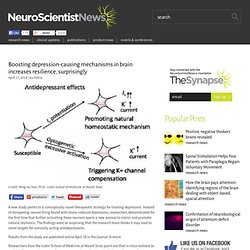
Instead of dampening neuron firing found with stress-induced depression, researchers demonstrated for the first time that further activating these neurons opens a new avenue to mimic and promote natural resilience. The findings were so surprising that the research team thinks it may lead to novel targets for naturally acting antidepressants.
Results from the study are published online April 18 in the journal Science. Just 1 Rock Concert or Football Game May Cause Permanent Hearing Damage. A single exposure to loud but not deafening noise may be enough to precipitate irreparable harm to nerves in the auditory system.
This is the take-home from a new line of research that may help explain why many people, particularly as they age, have difficulty in picking out a conversation from the wall of background noise that is a requisite accompaniment to any football game or meal at a family-style restaurant. Studies over the past five years in animals—with some evidence now coming from human research—are starting to overturn conventional wisdom about hearing loss.
Trauma can be inherited from parents. Mice exposed to high levels of stress were seen to exhibit depressive symptoms and their metabolism slowed down.
Those behavioural symptoms were also seen in their offspring even though the mice were not exposed to any traumatic stress themselves. The changes were ever found in third generation mice. “We were able to demonstrate for the first time that traumatic experiences affect metabolism in the long-term and that these changes are hereditary,” said Prof Mansuy. “With the imbalance in ‘microRNAs’ in sperm, we have discovered a key factor through which trauma can be passed on. “Most likely, it is part of a chain of events that begins with the body producing too much stress hormones.” After traumatic experiences, the mice behaved markedly differently: they partly lost their natural aversion to open spaces and bright light and had depressive-like behaviours.
Breakthrough therapy allows four paraplegic men to voluntarily move their legs. Four young men who have been paralyzed for years achieved groundbreaking progress—moving their legs—as a result of epidural electrical stimulation of the spinal cord, an international team of life scientists reports today in the medical journal Brain.
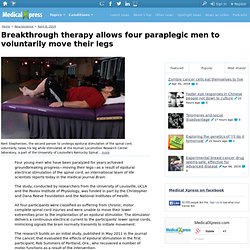
The study, conducted by researchers from the University of Louisville, UCLA and the Pavlov Institute of Physiology, was funded in part by the Christopher and Dana Reeve Foundation and the National Institutes of Health. All four participants were classified as suffering from chronic, motor complete spinal cord injuries and were unable to move their lower extremities prior to the implantation of an epidural stimulator. The stimulator delivers a continuous electrical current to the participants' lower spinal cords, mimicking signals the brain normally transmits to initiate movement.
New Method of Creating Stem Cells is a "Game Changer" STAP cells, glowing green, have been integrated into the mouse fetus’s body tissues.
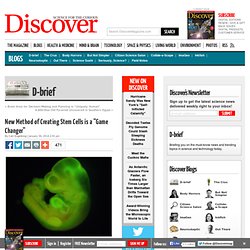
Credit: Haruko Obokata Researchers have observed that plants, when stressed, can reprogram their cells into stem cells, capable of differentiating into many different cell types. Now, it appears mammals can perform the same trick. Japanese scientists say they have successfully reverted blood cells back to their embryonic state after dipping them in a stress-inducing bath of acid. The team accomplished the feat using blood cells from mouse spleens, but are now trying to replicate it using human blood cells.
Game Changer Scientists currently deploy one of two methods to obtain stem cells: extract them from human embryos, or “reprogram” adult cells into a stem-cell state (called induced pluripotent stem cells, or iPS cells). Does Evolution Evolve Under Pressure? - Wired Science. Malcolm Gladwell: Do Genetic Advantages Make Sports Unfair? Toward the end of “The Sports Gene” (Penguin/Current), David Epstein makes his way to a remote corner of Finland to visit a man named Eero Mäntyranta.
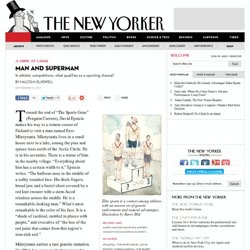
Mäntyranta lives in a small house next to a lake, among the pine and spruce trees north of the Arctic Circle. He is in his seventies. There is a statue of him in the nearby village. “Everything about him has a certain width to it,” Epstein writes. “The bulbous nose in the middle of a softly rounded face. Mäntyranta carries a rare genetic mutation. Longevity Gene: Discovery opens the door to a potential 'molecular fountain of youth' A new study led by researchers at the University of California, Berkeley, represents a major advance in the understanding of the molecular mechanisms behind aging while providing new hope for the development of targeted treatments for age-related degenerative diseases.
Older and fitter? New findings from a UC Berkeley-led study could have implications for the development of treatments for age-related degenerative diseases. Researchers were able to turn back the molecular clock by infusing the blood stem cells of old mice with a longevity gene and rejuvenating the aged stem cells' regenerative potential. The findings were published online on Jan. 31, in the journal Cell Reports. The biologists found that SIRT3, one among a class of proteins known as sirtuins, plays an important role in helping aged blood stem cells cope with stress. IMPORTANT MEDICAL DISCOVERY - CURE FOR CANCER, AIDS etc. Material stops bleeding in seconds. MIT and Hong Kong University researchers have shown that some simple biodegradable liquids can stop bleeding in wounded rodents within seconds, a development that could significantly impact medicine.
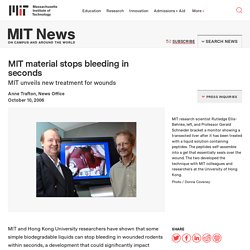
When the liquid, composed of protein fragments called peptides, is applied to open wounds, the peptides self-assemble into a nanoscale protective barrier gel that seals the wound and halts bleeding. Profits over your dead body. Imagine living in a world where visiting the doctor was an experience fraught with danger. Where the drugs you were prescribed may or may not be effective—and may or may not be safe. Imagine having a medical procedure recommended that wasn't known to work. Up until the beginning of the 20th century, that was the case. Drug research: Toxic medicine. This won’t hurt a bit “THERE are no poisons, only poisonous doses.” Thus did Paracelsus, the greatest of the alchemists, encapsulate an important piece of medical wisdom. Penn Medicine News: One Shot of Gene Therapy and Children with Congenital Blindness Can Now See. PHILADELPHIA – Born with a retinal disease that made him legally blind, and would eventually leave him totally sightless, the nine-year-old boy used to sit in the back of the classroom, relying on the large print on an electronic screen and assisted by teacher aides.
Now, after a single injection of genes that produce light-sensitive pigments in the back of his eye, he sits in front with classmates and participates in class without extra help. In the playground, he joins his classmates in playing his first game of softball. His treatment represents the next step toward medical science’s goal of using gene therapy to cure disease. Extending a preliminary study published last year on three young adults, the full study reports successful, sustained results that showed notable improvement in children with congenital blindness.
Burzynski: Cancer Is Serious Business. Hybrid 3-D Printer Used to Create Cartilage Implants. Athletes and arthritics rejoice: Wake Forest researchers have combined low-cost cell printing and electrospinning to create implantable cartilage. Photo courtesy IOP Publishing. Scientists at the Wake Forest Institute of Regenerative Medicine have pioneered an approach to replace damaged cartilage, combining two low-cost techniques. 11.19.2007 - New technique captures chemical reactions in a single living cell for the first time. UC Berkeley Press Release. BioFuel Cell Uses Glucose in the Body to Produce Electricity for Cyborgs. Biofuel cells turned glucose into electricity in rats. Researchers at Joseph Fourier University in France have created a new biofuel cell that harnesses oxygen and glucose from the body to produce electricity. Does The Family Really Need Lipitor and Aspirin? - ThePeoplesChemist.com. Tricks Foods Play. Tough gel stretches to 21 times its length, recoils, and heals itself: Biocompatible material much tougher than cartilage.
Researchers' cooling glove 'better than steroids' Dr. Karl Jansen. Chemical widely used in antibacterial hand soaps may impair muscle function. Triclosan, an antibacterial chemical widely used in hand soaps and other personal-care products, hinders muscle contractions at a cellular level, slows swimming in fish and reduces muscular strength in mice, according to researchers at the University of California, Davis, and the University of Colorado. Common parasite may trigger suicide attempts: Inflammation from T. gondii produces brain-damaging metabolites. Scientists can now block heroin, morphine addiction. Roid Age: the paradox of pharmacological puritanism. Injecting life-saving oxygen into a vein. Early gut bacteria regulate happiness.
MIT Develops a Magnetic Hypospray for Needleless Shots. The Beating Heart Donors. The Gruesome History of Eating Corpses as Medicine. Cancer 'cure' in mice to be tested in humans. Fine-tuning Nanotech to Target Cancer. Nathan Wolfe's jungle search for viruses. Mark Roth: Suspended animation is within our grasp. New View of Depression: An Ailment of the Entire Body. Data mining opens the door to predictive neuroscience. Tal Golesworthy: How I repaired my own heart.
Genetic 'Light Switches' Control Muscle Movement. Paul Root Wolpe: It's time to question bio-engineering. Alana B. Elias Kornfeld: TEDMED 2009: Using Sleep As A Gateway Into The Brain. Tyrone Hayes + Penelope Jagessar Chaffer: The toxic baby? Bill Doyle: Treating cancer with electric fields. Why do cells age? Discovery of extremely long-lived proteins may provide insight into cell aging and neurodegenerative diseases. Babies with three parents possible within three years. Cold Plasma Kills Bacteria Better Than Antibiotics. New bandage spurs, guides blood vessel growth. Deep-Brain Stimulation Found to Fix Depression Long-Term. New drug could cure nearly any viral infection. THE DRUG DOES WORK. New 'smart' material could help tap medical potential of tissue-penetrating light.
Cynthia Kenyon: Experiments that hint of longer lives. How Your Brain Could Fix Your Diabetes. 10 High-Tech Health Breakthroughs Coming Soon to Your Body.