
Armstrong.jpg (JPEG Image, 2560 × 1024 pixels) - Scaled (59%) NASA Science. Current position of the ISS. Sts126ferry1-788582.jpg (JPEG Image, 1600 × 1280 pixels) - Scaled (58%) Iss028e015808.jpg (Image JPEG, 4288x2848 pixels) - Redimensionnée (30%) Inverse Problem. Shuttle-Endeavour-sts130-nuit.jpg (Image JPEG, 1920x1277 pixels) - Redimensionnée (70%) Incredible Space Pics from ISS by NASA astronaut Wheelock.
Go Discovery!
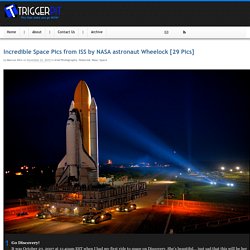
It was October 23, 2007 at 11:40am EST when I had my first ride to space on Discovery. She’s beautiful… just sad that this will be her last voyage. Looking forward to climbing aboard the flight deck when Discovery arrives at the Space Station in November. (9-23-2010). Incredible Photos from Space: Larry Tanner, NASA. Special thanks: Bethbeck’s blog On September 22, 2010, with the departure of the Expedition 23 crew, Colonel Douglas H. We thought that we should put some of the space photos together as a tribute to him and the whole ISS crew.
The following space photos are all visible on Astro_Wheels’ twitpic account, and we are eternally grateful to him for sharing these space photos with the world. Incredible Photos from Space: ‘Earthshine’… The Space Station basking in blue Earthshine as the rising sun pierces our razor-thin atmosphere to cover the Space Station with blue light. NASA astronaut Douglas H. Distances from the Sun. Space Shuttle Discovery - 360VR Images. Buzz Lightyear Floats Weightless On Space Station. Alcubierre Warp Drive Time Travel. An Alcubierre Warp Drive stretches spacetime in a wave causing the fabric of space ahead of a spacecraft to contract and the space behind it to expand.
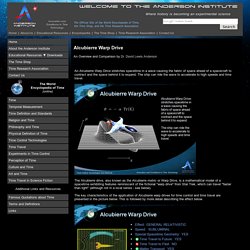
The ship can ride the wave to accelerate to high speeds and time travel. The Alcubierre drive, also known as the Alcubierre metric or Warp Drive, is a mathematical model of a spacetime exhibiting features reminiscent of the fictional "warp drive" from Star Trek, which can travel "faster than light" (although not in a local sense - see below). The key characteristics of the application of Alcubierre warp drives for time control and time travel are presented in the picture below. This is followed by more detail describing the effect below. Alcubierre Warp Drive Description. Moon in Stunning Detail - Boredstop.com. Video camera installed on rocket that reaches 121,000 ft.
Arecibo message. This is the message with color added to highlight its separate parts.
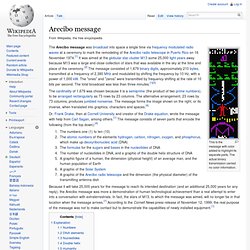
The actual binary transmission carried no color information. The Arecibo message was broadcast into space a single time via frequency modulated radio waves at a ceremony to mark the remodeling of the Arecibo radio telescope in Puerto Rico on 16 November 1974.[1] It was aimed at the globular star cluster M13 some 25,000 light years away because M13 was a large and close collection of stars that was available in the sky at the time and place of the ceremony.[2] The message consisted of 1,679 binary digits, approximately 210 bytes, transmitted at a frequency of 2,380 MHz and modulated by shifting the frequency by 10 Hz, with a power of 1,000 kW. The "ones" and "zeros" were transmitted by frequency shifting at the rate of 10 bits per second.
The total broadcast was less than three minutes.[1][3] Dr. Explanation[edit] Numbers[edit] DNA elements[edit] The numbers 1, 6, 7, 8 and 15 appear. Nucleotides[edit] Double helix[edit] Earth View. Laser Pumped Flying Saucer Spacecraft Welcome Home, Atlantis - Alan Taylor - In Focus. Today marks the end of an era.
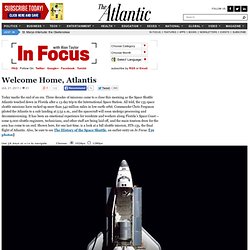
Three decades of missions came to a close this morning as the Space Shuttle Atlantis touched down in Florida after a 13-day trip to the International Space Station. All told, the 135 space shuttle missions have racked up more than 542 million miles in low earth orbit. Commander Chris Ferguson piloted the Atlantis to a safe landing at 5:52 a.m., and the spacecraft will soon undergo processing and decommissioning.
It has been an emotional experience for residents and workers along Florida's Space Coast -- some 9,000 shuttle engineers, technicians, and other staff are being laid off, and the main tourism draw for the area has come to an end. Shown here, for one last time, is a look at a full shuttle mission, STS-135, the final flight of Atlantis. Use j/k keys or ←/→ to navigate Choose: A view of the space shuttle Atlantis and its payload on July 10, 2011, seen from the International Space Station.
Crazy!!! Space Nuclear Test.