
Zend_Acl part 1: Misconceptions and simple ACLs. February 6, 2009 – 7:35 am Tags: Zend Framework, Zend_Acl I’m going to be writing a weekly series of posts on Zend_Acl.

This first post will clear up some common misconceptions regarding Zend_Acl, introduce creating ACLs for simple applications, and give some examples on using the ACL in both non-Zend Framework and Zend Framework applications. Later in the post series I’ll be talking about some more advanced ways of utilizing Zend_Acl, and topics such as database-backed ACLs. A russian translation of this post is available here, courtesy of Rashad Surkin. Zend_Acl misconceptions Many people think that the ACL “resource” and “privilege” are the same as the controller and the action. The resource in Zend_Acl can be anything – a controller, a file, a model… The privilege, just like the resource, can be anything related to the resource – for example, it could be an action if the resource is a controller, or it could be “read” or “write” if it’s a file or a model.
Building a simple ACL In closing. Settings Manager - Global Security Settin. Note: The Settings Manager that you see above is not an image; it is the actual Settings Manager itself.
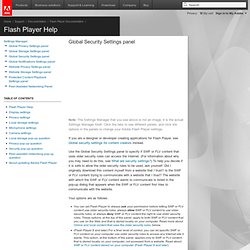
Click the tabs to see different panels, and click the options in the panels to change your Adobe Flash Player settings. If you are a designer or developer creating applications for Flash Player, see Global security settings for content creators instead. Use the Global Security Settings panel to specify if SWF or FLV content that uses older security rules can access the Internet. (For information about why you may need to do this, see What are security settings?) To help you decide if it is safe to allow the older security rules to be used, ask yourself: Did I originally download this content myself from a website that I trust?
Your options are as follows: If you do not allow SWF or FLV content to use the older security rules, the content might or might not function as intended. For an overview of issues relating to global security settings, see What are security settings? Developer Center : Distributing AIR in the enterprise. Additional Requirements Most users download and install AIR directly from the Adobe website.

Enterprise administrators, however, often distribute software to their users from a central location. To use this distribution method, you must first apply for and receive permission from Adobe. In the application process, which takes about five minutes, you provide contact information and an explanation about your intent to distribute. For more information about licensing and the license application, visit the Adobe AIR runtime distribution page.
After submitting your application and receiving approval from Adobe, you can distribute the AIR runtime on a closed intranet, through media such as CDs or DVDs, or as part of another native installation process. This article assumes that SMS, SCCM, or TPMX has been properly installed and configured. Home and business users can install Adobe AIR by downloading it directly from Adobe or as part of a seamless install process for a new AIR application. Stupid htaccess Tricks. Welcome to Perishable Press!

This article, Stupid htaccess Tricks, covers just about every htaccess “trick” in the book, and is easily the site’s most popular offering. In addition to this htaccess article, you may also want to explore the rapidly expanding htaccess tag archive. Along with all things htaccess, Perishable Press also focuses on (X)HTML, CSS, PHP, JavaScript, security, and just about every other aspect of web design, blogging, and online success.
If these topics are of interest to you, I encourage you to subscribe to Perishable Press for a periodic dose of online enlightenment ;) General Information [ ^ ] .htaccess Definition 1 ^ Apache server software provides distributed (i.e., directory-level) configuration via Hypertext Access files. Commenting .htaccess Code ^ Comments are essential to maintaining control over any involved portion of code. Important Notes for .htaccess Noobs ^ As a configuration file, .htaccess is very powerful. Performance Issues ^ [S=x] [E=variable:value]