
How to Embroider Jeans. Knit Simple Magazine. Embroidery is used to add another dimension to your work once the knitting and blocking is complete.
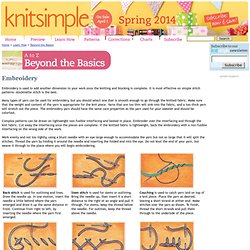
It is most effective on simple stitch patterns—stockinette stitch is the best. Many types of yarn can be used for embroidery, but you should select one that is smooth enough to go through the knitted fabric. Make sure that the weight and content of the yarn is appropriate for the knit piece. Yarns that are too thin will sink into the fabric, and a too-thick yarn will stretch out the piece. The embroidery yarn should have the same care properties as the yarn used for your sweater and should be colorfast. Complex patterns can be drawn on lightweight non-fusible interfacing and basted in place. Work evenly and not too tightly, using a blunt needle with an eye large enough to accommodate the yarn but not so large that it will split the stitches. Fish Bowl Embroidery. Embroidery How To Backstitch: Love Letters Thirty Handmade Days. Tacked herringbone stitch. This stitch is done with herringbone stitch as the base.
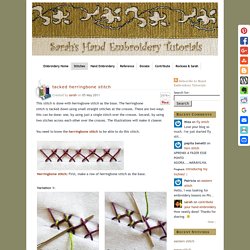
The herringbone stitch is tacked down using small straight stitches at the crosses. There are two ways this can be done: one, by using just a single stitch over the crosses. Second, by using two stiches across each other over the crosses. The illustrations will make it clearer.…. Tags: catch stitch, embroidery tutorial, hand embroidery, herringbone, herringbone stitch, indian embroidery, kutch work, mossoul stitch, plaited stitch, tacked herringbone stitch 14 Comments » Embroidery: Two Color Technique. One of my all time favorite craft books is The Constance Howard Book of Stitches.
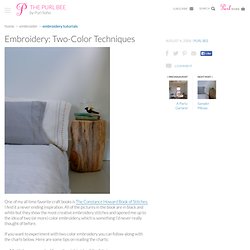
I find it a never ending inspiration. All of the pictures in the book are in black and white but they show the most creative embroidery stitches and opened me up to the idea of two (or more) color embroidery, which is something I'd never really thought of before. If you want to experiment with two color embroidery you can follow along with the charts below. Here are some tips on reading the charts: All stitches are worked from the right side of the fabric.The odd numbers represent a needle exit point and the even numbers represent the entry point.The red numbers represent the first thread color and the brown numbers indicate the second thread color. If all of this doesn't make much sense try following along with the first stitch below, Basic Weaving, where I explain the steps in full detail.
Basketweaving The idea behind the Basic Weaving stitch is very versatile and can be used in endless variations. Www.lollychops.com/Patterns/LollyChops_AWhaleOfAGoodTime.pdf. Embroidery Designs at Urban Threads - Projects. Now it's time to grab that other sock, provided it hasn't disappeared.
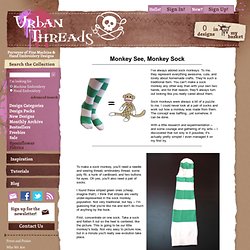
Don't laugh -- I have about a half dozen socks whose partners have mysteriously vanished. It can happen. Turn the sock inside out and flatten it the other way, so the heel is folded in half. This sock is much more picky as to what it turns into. The diagram to the left shows you what I mean. The long front half of the sock is the tail. Before cutting anything, I'll give you a bit of advice I learned the hard way: You'll notice the tail and the arms are the uppermost section.
Mermaid Circle PDF Embroidery pattern by littledear.