
Yoland Bresson : Le revenu d'existence ou la métamorphose d. Michael porter enterprise model. Inside the influential new world of econobloggers - The Boston G. DURING THE PANIC of 1907, the nation's most powerful banker, J.

P. Morgan, brokered a solution to the crisis behind the closed doors of his personal library in New York City. Faced with the total collapse of the financial system, Morgan gathered together the nation's banking titans into one wing of the library and locked the door, refusing to let them out until they had pledged to help one another through the crisis. Morgan stopped the panic in its tracks, and his modus operandi - hammering out deals in secrecy - has become the conventional method of managing threats to the nation's economy. This year, the response to the crisis on Wall Street started that way, too. This time, however, something strange happened. As the bailout plan unfolded, the bloggers offered historical context along with cutting critiques of the proposal.
The blogs offer a rolling crash course in economics as authoritative as any textbook, but far more accessible. . © Copyright 2008 Globe Newspaper Company. The Logic of Collective Action (page 4) Now that we know that smaller groups will generally be more successful than large ones, we understand why the government enacts many of the policies it does.

To illustrate how this works, I'm going to use a made-up example of such a policy. It's a very drastic over-simplification, but I think you'll agree it's not that far out. Suppose there are four major airlines in the United States, each of whom are near bankruptcy. The CEO of one of the airlines realizes that they can get out of bankruptcy by lobbying the government for support. He can convince the 3 other airlines to go along with the plan, as they realize that they'll be more successful if they band together and if one of the airlines does not participate the amount of lobbying resources will be greatly diminshed along with the credibility of their argument. Experiment - The Charity Study.
In April 2007, we embarked on a study into the psychology behind charity collections.

Was it possible, we wondered, to influence the amount donated to good causes by changing the appearance of the charity box? We teamed up with Borders bookstores and conducted a week-long secret study across Britain. Participating stores were sent four charity boxes, identical in shape and size, all advertising the same charity - the National Literacy Trust. Each carried one of four messages: "Please give generously", "Every penny helps", "Every pound helps", and "You can make a difference". The boxes were placed at randomly selected tills, and managers monitored the amount collected in each. Would the subtle changes in message make a significant impact on whether people donated their cash to charity? The answer was an irrefutable yes. Why should such a small change have such a big impact? Nterestingly, large variations in giving also emerged between the regions. Diffusion/accès : une économie de l'attention antagonique - Dans la continuité d'un billet récent, qui soulignait théoriquement la différence radicale entre l'économie de l'accès et celle de la diffusion, voici quelques éléments plus concrets sur les stratégies des acteurs, la structuration des marchés et les chiffres.
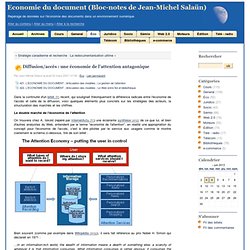
Le double marché de l'économie de l'attention On trouvera chez A. Iskold (repéré par InternetActu) une éclairante synthèse de ce que lui, et bien d'autres analystes du Web, entendent par le terme "économie de l'attention", en réalité une appropriation du concept pour l'économie de l'accès, c'est à dire pilotée par le service aux usagers comme le montre clairement le schéma ci-dessous, tiré de son billet : Bien souvent (comme par exemple dans Wikipédia), il sera fait référence au prix Nobel H.
Simon qui déclarait en 1971 : ...in an information-rich world, the wealth of information means a dearth of something else: a scarcity of whatever it is that information consumes. Mais H. Acteurs et mesure. La Banque des règlements internationaux averti du krach - Bankin. Pécher n'est pas faire le mal - Le vrai péché, c'est de ne pas faire le bien.

Pier Paolo Pasolini. La Royal Bank of Scotland prévoit un krach d’ici septembre Il y a chez Evans-Pritchard une certaine complaisance - assumée - au catastrophisme, ainsi qu’un penchant très britannique à se rejouir in petto des malheurs de l’Europe continentale, de l’euro et du modèle Rhénan.

Mais lorsque c’est la Royal Bank of Scotland qui prévoit que le krach est à nos portes, l’avertissement mérite sans doute d’être entendu. Par Ambrose Evans-Pritchard, 18 juin 2008 La Royal Bank of Scotland a averti ses clients de se préparer à un krach majeur des bourses mondiales et des marchés du crédit dans les trois prochains mois, au moment où l’inflation paralyse les possibilités d’action des grandes banques centrales. « Une période très dangereuse se rapproche rapidement - soyez prêts », met en garde Bob Janjuah, l’analyste stratégique de la banque écossaise. Une telle chute des bourses mondiales bourses créerait l’un des pires de marché baissier depuis un siècle. « Le cash constitue la principale protection.
. « La Fed est en mode panique.