
Benefits of Taking Fido to Work May Not Be Far “Fetched” Newswise — RICHMOND, Va.

(March 29, 2012) – Man’s best friend may make a positive difference in the workplace by reducing stress and making the job more satisfying for other employees, according to a Virginia Commonwealth University study. Stress is a major contributor to employee absenteeism, morale and burnout and results in significant loss of productivity and resources. But a preliminary study, published in the March issue of the International Journal of Workplace Health Management, found that dogs in the workplace may buffer the impact of stress during the workday for their owners and make the job more satisfying for those with whom they come into contact.
The VCU researchers compared employees who bring their dogs to work, employees who do not bring their dogs to work and employees without pets in the areas of stress, job satisfaction, organizational commitment and support. “Dogs in the workplace can make a positive difference,” he said. Randolph Barker collaborated with Janet S.
Www.apa.org/news/press/releases/stress/2011/impact.pdf. The Impact of Stress: 2011. Reported stress levels for Americans overall are continuing to drop and have reached their lowest point since 2007, when the Stress in America™ survey first began tracking stress levels.

While stress levels appear to be balancing out, they remain high and exceed what Americans consider to be healthy. Year after year, many Americans report extreme stress (22 percent in 2011; 24 percent in 2010 and 2009; 30 percent in 2008; and 32 percent in 2007) — an 8, 9 or 10 on a 10-point scale where 1 is little or no stress and 10 is a great deal of stress. These findings are indicative of a serious trend that could have long-term consequences on people’s health. Overall, people seem to recognize that stress can have an impact on health and well-being, but they do not necessarily take action to prevent stress or manage it well.
Survey findings also suggest that time management may be a significant barrier preventing people from taking the necessary steps to improve their health. Do You Suffer From Decision Fatigue? Case 1 (heard at 8:50 a.m.): An Arab Israeli serving a 30-month sentence for fraud.
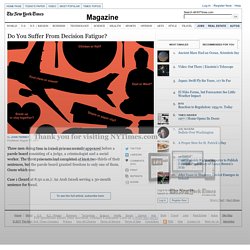
Case 2 (heard at 3:10 p.m.): A Jewish Israeli serving a 16-month sentence for assault. Case 3 (heard at 4:25 p.m.): An Arab Israeli serving a 30-month sentence for fraud. There was a pattern to the parole board’s decisions, but it wasn’t related to the men’s ethnic backgrounds, crimes or sentences. It was all about timing, as researchers discovered by analyzing more than 1,100 decisions over the course of a year. Judges, who would hear the prisoners’ appeals and then get advice from the other members of the board, approved parole in about a third of the cases, but the probability of being paroled fluctuated wildly throughout the day. The odds favored the prisoner who appeared at 8:50 a.m. — and he did in fact receive parole. There was nothing malicious or even unusual about the judges’ behavior, which was reported earlier this year by Jonathan Levav of Stanford and Shai Danziger of Ben-Gurion University. RELAXATION - SURPRISING BENEFITS DETECTED.
THE simple act of becoming relaxed can have surprising health benefits, new research is showing.

In addition to the obvious psychological effects of relieving stress and mental tension, the new findings indicate, deep relaxation, if practiced regularly, can strengthen the immune system and produce a host of other medically valuable physiological changes. In asthmatics, for example, relaxation training has been found to widen restricted respiratory passages.
In some diabetics, relaxation can reduce the need for insulin. In many patients with chronic, unbearable pain, the training has brought about significant relief. Moreover, the research shows, relaxation may help ward off disease by making people less susceptible to viruses, and by lowering blood pressure and cholesterol levels. Intensive Techniques Are Used Like meditation and yoga, some of the relaxation techniques being used are quite ancient. The Conscious Lifestyle: Facing Your Stress. Big Idea 2013: The Year We Prioritize Beating Stress. Harris Interactive poll: Almost 3 in 4 at work in U.S. are stressed. August 26, 2012|Tribune staff According to an annual survey by Harris Interactive, 73 percent of Americans are stressed at work.

The top source of stress, felt by 11 percent of survey respondents, is low wages. For women, that rises to 14 percent. The next irritants are annoying co-workers (10 percent); commuting (9 percent); workload (9 percent); and a job outside a chosen career (8 percent). But workers' fear of losing their job dropped to 4 percent, from 9 percent in 2011. Still, "anxiety among employees reduces productivity, lessens job satisfaction, lowers morale and has a negative impact on health," survey spokesman John Swartz, regional director of career services at Everest College, which commissioned the survey, said in a statement.