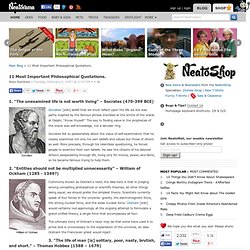
Suicide Note. Nietzsche Quotes: Will to Power. Suppose nothing else were "given" as real except our world of desires and passions, and we could not get down, or up, to any other "reality" besides the reality of our drives--for thinking is merely a relation of these drives to each other: is it not permitted to make the experiment and to ask the question whether this "given" would not be sufficient for also understanding on the basis of this kind of thing the so-called mechanistic (or "material") world?...
Prof. Jason Read Quote. Puddle Thinking. An Essay by Einstein. "How strange is the lot of us mortals!

Each of us is here for a brief sojourn; for what purpose he knows not, though he sometimes thinks he senses it. But without deeper reflection one knows from daily life that one exists for other people -- first of all for those upon whose smiles and well-being our own happiness is wholly dependent, and then for the many, unknown to us, to whose destinies we are bound by the ties of sympathy.
A hundred times every day I remind myself that my inner and outer life are based on the labors of other men, living and dead, and that I must exert myself in order to give in the same measure as I have received and am still receiving... "I have never looked upon ease and happiness as ends in themselves -- this critical basis I call the ideal of a pigsty.
Ideological Graphics & Definitions. Anxiety and Depression: A Philosophical Investigation. Summer 1999, Vol. 1, Issue 1.

Anxiety and Depression: A Philosophical Investigation Petra von Morstein ... It is death That is ten thousand deaths and evil death.. Be tranquil in your wounds. That puts an end to evil death and dies. Be tranquil in your wounds. Shall be gentler for the death you die. Unsolved Philosophical Problems. This is a list of some of the major unsolved problems in philosophy.

Clearly, unsolved philosophical problems exist in the lay sense (e.g. You Always Hurt the One You Love. You always hurt the one you love, the one you should not hurt at all; You always take the sweetest rose, and crush it till the petals fall; You always break the kindest heart, with a hasty word you can't recall; So if I broke your heart last night, it's because I love you most of all. ( The Mills Brothers ) It is easy to understand why someone who doesn't love another person might break the heart of this person-when we do not love those who love us, we are likely to hurt them.

Philosophy is at Zero Point. For disciples of Western philosophy, the gathering of the sages happens each year in a Swiss Alpine resort.

Secluded among the peaks where thin air brings reverie, the world’s most prominent intellectuals welcome an eclectic mix of students – artists, thinkers and eccentrics – into their midst. Only here, at an experimental institution known as the European Graduate School, is one granted access to Slavoj Žižek, Alain Badiou, Avital Ronell, Giorgio Agamben, Judith Butler, Michael Hardt, Jacques Rancière and Jean-Luc Nancy among others. This congregation of masters lasts for three weeks of seminars, night lectures and communal dinner discussion. No other school in the world boasts a more exceptional faculty whose calling is to philosophize. But ultimately what makes the European Graduate School unique is the educational style. In the four years since I began my studies at the European Graduate School, I have always returned home with a deep insight into the direction of our culture. Hedgehog's Dilemma.
Both Arthur Schopenhauer and Sigmund Freud have used this situation to describe what they feel is the state of individual in relation to others in society.
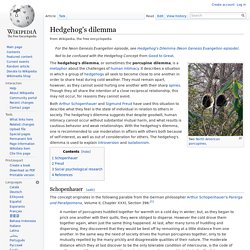
The hedgehog's dilemma suggests that despite goodwill, human intimacy cannot occur without substantial mutual harm, and what results is cautious behavior and weak relationships. With the hedgehog's dilemma, one is recommended to use moderation in affairs with others both because of self-interest, as well as out of consideration for others. The hedgehog's dilemma is used to explain introversion and isolationism. Schopenhauer[edit] The concept originates in the following parable from the German philosopher Arthur Schopenhauer's Parerga und Paralipomena, Volume II, Chapter XXXI, Section 396:[1] A number of porcupines huddled together for warmth on a cold day in winter; but, as they began to prick one another with their quills, they were obliged to disperse.
Freud[edit] Social psychological research[edit] References[edit] Allegory of the Cave. Plato realizes that the general run of humankind can think, and speak, etc., without (so far as they acknowledge) any awareness of his realm of Forms.
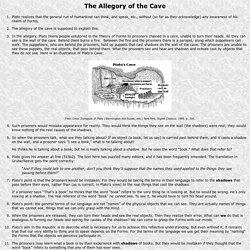
The allegory of the cave is supposed to explain this. In the allegory, Plato likens people untutored in the Theory of Forms to prisoners chained in a cave, unable to turn their heads. All they can see is the wall of the cave. Behind them burns a fire. Between the fire and the prisoners there is a parapet, along which puppeteers can walk. Harry Frankfurt's "On Bullshit".
One of the most salient features of our culture is that there is so much bullshit. Everyone knows this. Each of us contributes his share. But we tend to take the situation for granted. Most people are rather confident of their ability to recognize bullshit and to avoid being taken in by it. 11 Most Important Philosophical Statements. 1.