
Marx on the alienation of work: When human becomes animal. I had not seen this passage until I read it in "Lapham's Quarterly", an excellent new journal of history and ideas.

It is taken from Karl Marx's Economic and Philosophic Manuscripts (1884). According to Lapham's Quarterly, this text was not published until 1959. One could hardly find a more eloquent description of the fundamental alienation wrought by work. Work is not spontaneous activity, but belongs to another; it comprises a loss of self.
"It is true that labor produces for the rich wonderful things—but for the worker it produces privation. Soc 250 - Marx on Alienation. Sociology 250 January 27, 2003 Marx on Alienation Quotes noted below are quotes from the January 22, 2003 handout “Selected quotes on alienation from Marx.” 1.

Background In his university studies in Germany, Marx was primarily concerned with philosophical issues, specifically the philosophy of Hegel and his followers. In Paris, industry and the working class were more fully developed in economic and political terms than they were in Germany. The Manuscripts were especially important in developing Marx's thought beyond the Hegelian approach. 2. The first major topic of the Manuscripts is alienation, a term that has many interpretations. Marx uses alienation in several ways. Estranged Labour, Marx, 1844. Economic and Philosophical Manuscripts of 1844.

Karl Marx Estranged Labour ||XXII| We have proceeded from the premises of political economy. We have accepted its language and its laws. We presupposed private property, the separation of labor, capital and land, and of wages, profit of capital and rent of land – likewise division of labor, competition, the concept of exchange value, etc. Political economy starts with the fact of private property; it does not explain it to us.
Now, therefore, we have to grasp the intrinsic connection between private property, greed, the separation of labor, capital and landed property; the connection of exchange and competition, of value and the devaluation of man, of monopoly and competition, etc. – the connection between this whole estrangement and the money system. Do not let us go back to a fictitious primordial condition as the political economist does, when he tries to explain. We proceed from an actual economic fact. Estranged labor turns thus: Marx on Alienation. Marx: Capitalism and Alienation Karl Marx (1818-83) grew up in Germany under the same conservative and oppressive conditions under which Kant and other German philosophers had to live.

The Enlightenment had had some liberating effects on German life here and there, but most German principalities were still autocratic, and the idea of democracy was combated by all their rulers. The presence of police spies at major universities was a regular feature of German student life, and some students served long prison sentences for their political activism. As a law and philosophy student at the University of Berlin, Marx joined a political club that advocated political democracy. Very soon after receiving his doctorate, however, his ideas went beyond mere political reform. It was not until the 20th century that scholars found an unpublished study by Marx, the so-called Economic and Philosophical Manuscripts of 1844. There are some things here to which one may want to object. Marx's theory of alienation. The 19th-century German intellectual K.H.
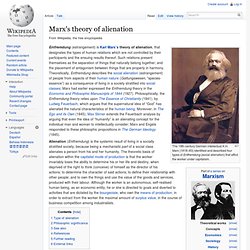
Marx (1818–83) identified and described four types of Entfremdung (social alienation) that afflict the worker under capitalism. Entfremdung (estrangement) is Karl Marx’s theory of alienation, that designates the types of human relations which are not controlled by their participants and the ensuing results thereof. Such relations present themselves as the separation of things that naturally belong together; and the placement of antagonism between things that are properly in harmony. Theoretically, Entfremdung describes the social alienation (estrangement) of people from aspects of their human nature (Gattungswesen, “species-essence”) as a consequence of living in a society stratified into social classes; Marx had earlier expressed the Entfremdung theory in the Economic and Philosophic Manuscripts of 1844 (1927). Type of alienation[edit] Let us suppose that we had carried out production as human beings.