
Marc
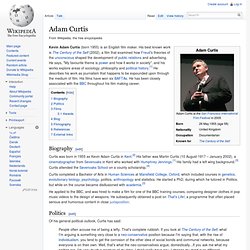
The Trivium & Quadrivium Re-Education. Into The Fire - Full Film. James Burke : "After The Warming", 11/11. Peter Joseph's Response to Stefan Molyneux [Zeitgeist: Moving Forward] Adam Curtis. Biography[edit] Curtis was born in 1955 as Kevin Adam Curtis in Kent.[2] His father was Martin Curtis (10 August 1917 – January 2002), a cinematographer from Sevenoaks in Kent who worked with Humphrey Jennings.[1] His family had a left wing background.[3] Curtis attended the Sevenoaks School on a county scholarship.[4] Curtis completed a Bachelor of Arts in Human Sciences at Mansfield College, Oxford, which included courses in genetics, evolutionary biology, psychology, politics, anthropology and statistics.
He started a PhD, during which he tutored in Politics, but while on the course became disillusioned with academia.[3] He applied to the BBC, and was hired to make a film for one of the BBC training courses, comparing designer clothes in pop music videos to the design of weapons. He subsequently obtained a post on That's Life! The Century Of The Self - Adam Curtis. Edward Bernays. PROPAGANDA.pdf. Sigmund Freud. Sigmund Freud (/frɔɪd/;[2] German pronunciation: [ˈziːkmʊnt ˈfʁɔʏ̯t]; born Sigismund Schlomo Freud; 6 May 1856 – 23 September 1939) was an Austrian neurologist, now known as the father of psychoanalysis.
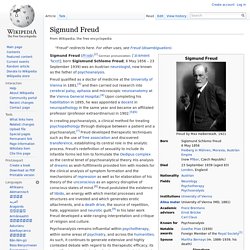
Freud qualified as a doctor of medicine at the University of Vienna in 1881,[3] and then carried out research into cerebral palsy, aphasia and microscopic neuroanatomy at the Vienna General Hospital.[4] Upon completing his habilitation in 1895, he was appointed a docent in neuropathology in the same year and became an affiliated professor (professor extraordinarius) in 1902.[5][6] Psychoanalysis remains influential within psychotherapy, within some areas of psychiatry, and across the humanities. As such, it continues to generate extensive and highly contested debate with regard to its therapeutic efficacy, its scientific status, and whether it advances or is detrimental to the feminist cause.[10] Nonetheless, Freud's work has suffused contemporary Western thought and popular culture.
The Father of Spin: Edward L. Bernays and the Birth of PR. The Center for Media and Democracy publishes a regular email update of our breaking news and investigative reporting that is available right to your inbox.
To receive this publication, simply enter your email address in the box that says "get email updates" in the upper right-hand corner of this webpage. In addition to our published work on our websites -- PRWatch.org, ALECexposed, SourceWatch, BanksterUSA, and the Food Rights Network -- CMD previously published a periodical available by subscription. In late 2008, the Center for Media and Democracy stopped printing its quarterly paper summary of our reporting, known as PR Watch, which had been launched in 1994 -- before online communications became the dominant way people chose to receive this news.
Since then, CMD has focused on our online publications, featuring original investigative reporting and analysis of the public relations industry and spin. To help fund this work, you can make a contribution here. THE TRAP. Ayn Rand. Literary critics received Rand's fiction with mixed reviews,[6] and academia generally ignored or rejected her philosophy, though academic interest has increased in recent decades.[7][8][9] The Objectivist movement attempts to spread her ideas, both to the public and in academic settings.[10] She has been a significant influence among libertarians and American conservatives.[11] Life[edit] Early life[edit] Rand was born Alisa Zinov'yevna Rosenbaum (Russian: Али́са Зиновьевна Розенбаум) on February 2, 1905, to a Russian Jewish bourgeois[12] family living in Saint Petersburg.
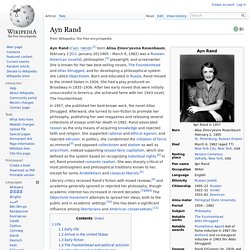
She was the eldest of the three daughters of Zinovy Zakharovich Rosenbaum and his wife, Anna Borisovna (née Kaplan), largely non-observant Jews. The subsequent October Revolution and the rule of the Bolsheviks under Vladimir Lenin disrupted the life the family had previously enjoyed. Along with many other "bourgeois" students, Rand was purged from the university shortly before graduating. The Ayn Rand Institute: News and Highlights. Positive and Negative Liberty. 1.
Two Concepts of Liberty Imagine you are driving a car through town, and you come to a fork in the road. You turn left, but no one was forcing you to go one way or the other. Next you come to a crossroads. You turn right, but no one was preventing you from going left or straight on. This story gives us two contrasting ways of thinking of liberty. In a famous essay first published in 1958, Isaiah Berlin called these two concepts of liberty negative and positive respectively (Berlin 1969).[1] The reason for using these labels is that in the first case liberty seems to be a mere absence of something (i.e. of obstacles, barriers, constraints or interference from others), whereas in the second case it seems to require the presence of something (i.e. of control, self-mastery, self-determination or self-realization). It is useful to think of the difference between the two concepts in terms of the difference between factors that are external and factors that are internal to the agent. 2. 3.
THE POWER OF NIGHTMARES.