
Historia de IRC. New Computer Programming Language Imitates The Human Brain. It could be a computer, but I agree that it is not "certainly" a type of computer.
We don't know enough about the human mind to categorize it as a computer. Computer: Programmable machine that can store, retrieve, and process data. We may have awesome computer brains...but they are still computers. How to reconstruct speech from a silent video of a crisp packet. Researchers have developed an algorithm that can use visual signals from videos to reconstruct sound and have used it to recover intelligible speech from a video of a crisp packet filmed from 15 feet away.

Oh, and to make sure there was definitely no cheating, the crisp packet was also placed behind soundproof glass. The Never-Before-Told Story of the World's First Computer Art (It's a Sexy Dame) - Benj Edwards. In the late 1950s, an anonymous IBM employee made a lady from the pages of Esquire come to life on the screen of a $238 million military computer.
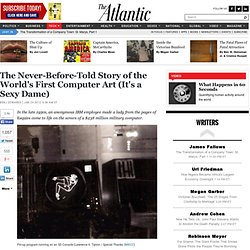
Pin-up program running on an SD Console (Lawrence A. Tipton / Special Thanks SMECC) Jacquard looms: Videos demonstrating early computer programs. Invented in 1801, Jacquard looms are really an add-on to already existent mechanical loom systems, which allowed those looms to create patterns more complex and intricate than anything that had been done before.

The difference: Punch cards. When you weave, the pattern comes from changes in thread position — which threads were exposed on the surface of the cloth and which were not.
Frankenstein Computer Virus Assembles Itself. A "Frankenstein" computer virus could assemble itself using pieces of code from common, legitimate software on people's computers, researchers demonstrated.

The patchwork malware would be especially difficult for anti-virus software to detect, so it could go into a government-made program that infiltrates others' computers, the New Scientist reported. Computer scientists have previously theorized that it's possible to create any program by combining gadgets, or bits of code that perform specific tasks. Vishwath Mohan and Kevin Hamlen of the University of Texas at Dallas created a demonstration of such a virus by writing a program that infects a computer, finds gadgets in programs such as Internet Explorer and Notepad, then builds itself two functions.
The two functions are simpler versions of what full-blown malware needs to do, showing this method's potential, Hamlen explained to the New Scientist. Mohan and Hamlen's research was supported in part by the U.S. This is the First Photo Ever Uploaded to the Web : Discoblog. Alan Turing's Legacy Lives On. When the history books of the future are written, Alan Turing will go down in the company of Newton and Darwin and Einstein.

His visions changed how humanity conceives of computation, information and pattern -- and 100 years after his birthday, and 58 years after his tragic death, Turing's legacy is alive and growing.In celebration of his achievements, the Royal Society, the world's oldest scientific fellowship -- Newton was once its president -- published two entire journal issues devoted to Turing's ongoing influence. On the following pages, Wired looks at some of the highlights.Above:Turing at WarThough he hardly fit the image of a soldier, Alan Turing had the heart of one.
With war on the horizon, Turing joined the British government's codebreaking office in 1938, and one year later turned the full force of his intellect on Enigma, the seemingly uncrackable German cryptography system. "No one else was doing anything about it and I could have it to myself," he said of his decision. Infinity Imagined. The Homebrew Computer Club. Today in Cyberpunk History (March 5, 1975): A group of tech-minded guys meet at a garage in Menlo Park, San Mateo County, California, USA for the first time.

They gathered to discuss the first Micro Instrumentation and Telemetry Systems Altair microcomputer. MITS was founded in 1969 by Ed Roberts and Forrest Mims to make electronic telemetry for model rockets before switching to electronic calculators in 1971. When a pricing war left MITS near bankruptcy in 1974, Roberts developed the Altair 8800. When 1975 came around, the Altair 8800 became the popular computer, and many organizations began forming to debate, discuss, share, and trade ideas, schematics, and even programs for it. Apple Shouldn’t Make Software Look Like Real Objects. Last fall Apple fired executive Scott Forstall, considered by many to be a Steve Jobs protégé.

His departure prompted a flurry of discussion about a formerly obscure design-industry concept that he had championed: “skeuomorphism.” In the physical world, a skeuomorph is an ornamental version of something that was, in an earlier product, a functional necessity. Home - Doug Engelbart Institute. Hackstory. The First Computer Bug!
Historia de la Tecnología: Red Aloha. Hace 40 años, con ARPANET recién nacida, seguramente nadie podía imaginar la importancia que iban a tener, hoy en día, las comunicaciones de datos.

Uno de los estándares más utilizados hoy en día es el al IEEE 802.3, también conocido como Ethernet, un estándar de comunicación para redes de área local que se basa en un protocolo que se comenzó a gestarse en Hawaii mientras se diseñaba una de las primeras redes inalámbricas de la historia: la Red Aloha. El Estado de Hawaii está situado en el océano Pacífico central y, entre otros atractivos, es una zona en la que hay gran afición al surf. Historia de la Tecnología: Cybersyn. The iPad of 1935. Motherboard TV: Douglas Rushkoff in Real Life.
A Piece of Email History Comes to the American History Museum. A Community for Classic Computing and Restoration Projects. Historia de la tecnología: el Mouse. La gran mayoría de usuarios que utilizan interfaces gráficas (GUI) para trabajar con sus computadoras, además del imprescindible teclado, suelen utilizar un dispositivo adicional que sirve para navegar por el interfaz gráfico, activar aplicaciones o manejar las opciones de un menú de una manera cómoda y sencilla, es decir, usan un mouse o ratón.

Douglas Engelbart (Premio Turing en 1997) era un veterano de la Segunda Guerra Mundial que sirvió como operador de radar en las Filipinas y, al finalizar la contienda, regresó a Estados Unidos a cursar estudios de Ingeniería Eléctrica en la Universidad Estatal de Oregon, de la que se graduaría en 1948 y, posteriormente, obtendría el título de grado de Ingeniería de la Universidad de Berkeley (1952) y un Doctorado en la misma Universidad en 1955. No éramos conscientes en aquel momento de que, incluso una década después, seguiría siendo algo único, y yo me sentí muy defraudado en los meses que siguieron. Imágenes: Wikipedia y Vintage Computer. Japan’s Cyber-Attack System “Pure Ghost in the Shell. A Japanese-developed cyber-attack warning visualisation system has lately been earning massive praise for its beautiful graphics, and almost as attention again for its unmistakable similarities to a certain cyberpunk anime… A video demonstrating the system, dubbed DAEDALUS (“Direct Alert Environment for Darknet And Livenet Unified Security”) and developed by NICT: Briefly, the trails passing from the central sphere (the Internet) to the orbiting circles (networks) represent external traffic, and generate alerts if identified as suspicious, and the system also identifies and displays traffic patterns passing between networks.
A major objective of the system is monitoring malware activity within and without the network, and watching for DDoS attacks. The system generates its alerts as XML data which can also be displayed as the boring charts and graphs full of endless hack attempts familiar to anyone charged with monitoring a computer connected to the Internet. Yes, Government Researchers Really Did Invent the Internet. “It’s an urban legend that the government launched the Internet,” writes Gordon Crovitz in an opinion piece in today’s Wall Street Journal.
Most histories cite the Pentagon-backed ARPANet as the Internet’s immediate predecessor, but that view undersells the importance of research conducted at Xerox PARC labs in the 1970s, claims Crovitz. Internet First Imagined in 1934. Forget Al Gore. The Internet — at least as a concept — was invented nearly a century ago by a Belgian information expert named Paul Otlet imagining where telephones and television might someday go. That was one of the topics in a wild discussion on the history of the Internet, and its future, at the recent World Science Festival in New York City. Internet History Timeline: ARPNET to the World Wide Web. Credit for the initial concept that developed into the World Wide Web is typically given to Leonard Kleinrock. F&*#ing Internet, how does it work? For the next 60 years or so—basically, until everyone roughly my age has died off—former Alaskan senator Ted Stevens will be widely remembered (and mocked) for once describing the Internet as "a series of tubes".
But here's the thing. It's easy to make fun of Ted Stevens. It's harder (much harder) to explain quickly and at a relatively simple level—for lay people with no tech background—what actually happens when they call up a web page. Personal Computing Timeline. The computer was born not for entertainment or email but out of a need to solve a serious number-crunching crisis.
By 1880, the U.S. population had grown so large that it took more than seven years to tabulate the U.S. Census results. The government sought a faster way to get the job done, giving rise to punch-card based computers that took up entire rooms. Today, we carry more computing power on our smartphones than was available in these early models. The following brief history of computing is a timeline of how computers evolved from their humble beginnings to the machines of today that surf the Internet, play games and stream multimedia in addition to crunching numbers. Historia de la Tecnología: Xerox PARC. Muchos de los productos tecnológicos que utilizamos hoy en día y que, prácticamente, se han convertido en objetos de uso cotidiano en nuestro día a día proceden del esfuerzo y visión de unas cuantas personas que dedicaron gran parte de su tiempo a la innovación y, por tanto, a pensar que era posible llegar más lejos. IBM Simulates 4.5 percent of the Human Brain, and All of the Cat Brain.
Supercomputers can store more information than the human brain and can calculate a single equation faster, but even the biggest, fastest supercomputers in the world cannot match the overall processing power of the brain. And they are nowhere near as compact or energy efficient. A Brief Rant on the Future of Interaction Design.
10 curiosidades para celebrar 40 años de UNIX. UNIX es el padre. Sí, por lo menos lo es de los sistemas operativos dominantes en la nube (GNU/Linux, Solaris, FreeBSD...) y en los móviles (iOS, Android...). Gobierno suizo: descargar películas y música es legal. Darwin trumps self-obsession in robotics - tech - 12 November 2011. 5 Tiny Computer Glitches That Caused Huge Disasters. Remembering a remarkable Soviet computing pioneer. Historia de la Tecnología: Commodore 64. Historia de la Tecnología: Zilog Z80. Los 10 mejores hacks de Kinect. Lockheed's F-22 Raptor Gets Zapped by International Date Line. Las visualizaciones de redes y su asombrosa complejidad. Millones de móviles de todo el mundo son agresivamente vigilados por Carrier IQ. Tech Leaders Discuss Promise and Pitfalls of Global Cyberspace. Information theory. How innovative is Apple's new voice assistant, Siri? - tech - 03 November 2011. The Machine That Would Predict the Future.
Pandoglobalstudy.pdf (application/pdf Objeto) One Per Cent: Anonymous' 'Robin Hood' attacks may benefit banks. What Is the Future of Knowledge in the Internet Age? Singularidad tecnológica. What if you could collect all of the world's data into one place? Computer History Museum - Restoring the DEC PDP-1 Computer Exhibit. Computer History Museum. See how Turing accidentally invented the computer. Training Simulator Software Industries. The real you: Say goodbye to online anonymity - science-in-society - 03 November 2011. 9 Inventions Whose Time Has Come. Bundled, Buried & Behind Closed Doors. TECHNOREALISM. Explore The Galaxy Using The Actual "Minority Report" Interface.
How Google Works - Infrastructure - News & Reviews - Baseline.com. Magazine - As We May Think. Brief History of the Internet.