
General Sherman, the biggest tree in the world. The tree called "General Sherman" is not only the biggest giant sequoia, but it is also the biggest tree in the world.
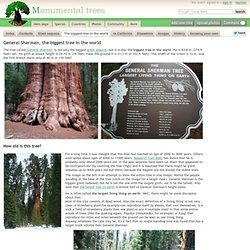
He is 83.8 m (274.9 feet) tall, his girth at breast height is 24,10 m (79 feet) (near the ground it is 31,3 m or 102,6 feet). The width of the crown is 33 m, and the first branch starts only at 40 m or 130 feet! How old is this tree? For a long time it was thought that this tree had reached an age of 2000 to 3000 years.
Others even spoke about ages of 6000 to 11000 years. The image on the left is an attempt to show the entire tree in one image. He is often called the largest living thing on earth. During a winter storm in 2006 the tree lost a large branch. Above are some typical views of General Sherman and his neighborhood during the touristic summer season. Tree volume calculation The official number mentioned on the info panel near the tree is 52500 cubic feet, or, in decimal units, 1487 m³. Tallest, thickest, oldest? Tallest tree in the world?
Largest girth? Strange skies: Seven wonders of the atmosphere. Cookies on the New Scientist website close Our website uses cookies, which are small text files that are widely used in order to make websites work more effectively.

To continue using our website and consent to the use of cookies, click away from this box or click 'Close' Find out about our cookies and how to change them Log in Your login is case sensitive I have forgotten my password close My New Scientist Look for Science Jobs Strange skies: Seven wonders of the atmosphere (Image: Roger Hill/Science Photo Library) We are creatures of the air more than any other of the classical elements. Cosmic confusion in the clouds Where do clouds come from? Invisible beings that live far above Few creatures soar as high as the invisible denizens of Earth's skies. Turbocharged auroras Most of the time the northern and southern lights are barely perceptible to the naked eye.
Mighty air tides Lightning should be impossible Lightning is almost as puzzling to modern science as it was to our awestruck ancestors. What are Noctilucent Clouds? Types of Clouds & Cloud Shapes. Every summer since the late 19th century, Earth's polar skies have lit up with eerie blue-white glowing clouds, slowly twisting and undulating in the twilight sky.

These mystifying clouds are referred to as "night-shining" clouds, or noctilucent clouds. Such clouds form in an upper layer of the Earth's atmosphere called the mesosphere during the summer and can be seen from the high latitudes on Earth. [See images of these mysterious clouds .] Volcano drew attention A series of massive eruptions from the Krakatau volcano (also spelled Krakatoa) in late August 1883 may have serendipitously helped to draw attention to the phenomenon of noctilucent clouds.
Dust and ash injected high into the atmosphere from the Indonesian volcano caused spectacular and colorful sunsets worldwide for several years. On the evening of June 8, 1885, T. But after a few more years, the ash settled and the vivid sunsets induced by Krakatoa faded. And yet the noctilucent clouds persisted. What causes them How to see them.