
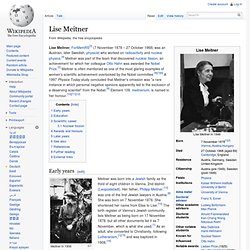
Lise Meitner. Lise Meitner, ForMemRS[3] (7 November 1878 – 27 October 1968) was an Austrian, later Swedish, physicist who worked on radioactivity and nuclear physics.[4] Meitner was part of the team that discovered nuclear fission, an achievement for which her colleague Otto Hahn was awarded the Nobel Prize.[5] Meitner is often mentioned as one of the most glaring examples of women's scientific achievement overlooked by the Nobel committee.[6][7][8] A 1997 Physics Today study concluded that Meitner's omission was "a rare instance in which personal negative opinions apparently led to the exclusion of a deserving scientist" from the Nobel.[9] Element 109, meitnerium, is named in her honour.[10][11][12] Early years[edit] Meitner in 1906 Meitner was born into a Jewish family as the third of eight children in Vienna, 2nd district (Leopoldstadt).
Her father, Philipp Meitner,[13] was one of the first Jewish lawyers in Austria.[8] She was born on 7 November 1878. Education[edit] Scientific career[edit] Chien-Shiung Wu. Life[edit] Wu was born in the town of Liuhe in Taicang, Jiangsu province, China, about 40 miles (64 km) from Shanghai on May 31, 1912.[3] Her father Wu Zhongyi (吳仲裔) encouraged her to attend a class taught by Hu Shih, a leading Chinese philosopher and scholar at the time.

She and her father were extremely close and he encouraged her interests passionately, creating an environment where she was surrounded by books, magazines, and newspapers.[4] Wu left her hometown at the age of 11 to go to the Suzhou Women's Normal School No. 2. In 1929 Wu was admitted to the National Central University in Nanjing. According to the governmental regulations of the time, "normal school" (teacher-training college) students wanting to move on to the universities needed to serve as schoolteachers for one year.
Hence, in 1929 Wu went to teach in the Public School of China (中國公學), founded by Hu Shih in Shanghai. Career[edit] Early work[edit] Chien-Shiung Wu in 1958 at Columbia University. Leó Szilárd. Leó Szilárd (Hungarian: Szilárd Leó; German: Leo Spitz until age 2; February 11, 1898 – May 30, 1964) was a Hungarian-American physicist and inventor.
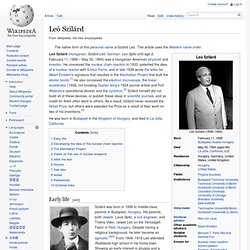
He conceived the nuclear chain reaction in 1933, patented the idea of a nuclear reactor with Enrico Fermi, and in late 1939 wrote the letter for Albert Einstein's signature that resulted in the Manhattan Project that built the atomic bomb.[1] He also conceived the electron microscope, the linear accelerator (1928, not knowing Gustav Ising's 1924 journal article and Rolf Widerøe's operational device) and the cyclotron.[2] Szilárd himself did not build all of these devices, or publish these ideas in scientific journals, and so credit for them often went to others.
As a result, Szilárd never received the Nobel Prize, but others were awarded the Prize as a result of their work on two of his inventions.[3] He was born in Budapest in the Kingdom of Hungary, and died in La Jolla, California. Early life[edit] Leo Szilárd at age 18.