
F-Shaped Pattern For Reading Web Content. Among NN/g’s contributions to the world of UX, perhaps one of the most cited is the F-shaped reading pattern for web content, which we identified in 2006. Over the years, many have referred to this research, sometimes correctly, and in many other instances misinterpreting it. In this article, we aim to report on recent research revisiting it and also to clarify some of the misconceptions related to the F-pattern.
In particular: Scanning on the web does not always take the shape of an F. There are other common scanning patterns too.The F-pattern is negative for users and businesses.Good design can prevent F-shape scanning. The F-Shaped Pattern. Getting_students_to_read. Cult of Pedagogy. Institute for Writing and Rhetoric. Though the connection between reading and writing seems to be a "given," reading was not always a dominant force in writing classrooms.
In the nineteenth century, students did not typically write analyses of what they read, but instead wrote themes on prescribed topics, such as Vanity, Democracy, Ethics, and so on. Reading and writing became curricularly linked at the turn of the century, when Harvard and other universities decided that reading literature was essential to learning to write. The reasons for this curricular link are the same today as they were one hundred years ago.
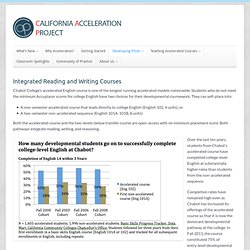
Howtostudy.org - When you hit the books - and they hit back. Graphic Organizers. Developmental English Instructor Product Details Page - Fusion: Integrated Reading and Writing, Book 2 (1133312497) Acceleration Project CA CCs. Integrated Reading and Writing Courses. Chabot College’s accelerated English course is one of the longest running accelerated models nationwide.
ALP_Faculty_Handbook_12_12. Graphic Organizers. Prepared by Tracey Hall & Nicole Strangman Please visit the AIM Center home page.
Introduction One way to help make a curriculum more supportive of students and teachers is to incorporate graphic organizers. Graphic organizers come in many varieties and have been widely researched for their effectiveness in improving learning outcomes for various students. The following five sections present a definition of graphic organizers, a sampling of different types and their applications, a discussion of the research evidence for their effectiveness, useful Web resources, and a list of referenced research articles. The Network for College Readiness Assignment Field Testing in Texas. Homepage - ReadWriteThink. Developmental English - Interactions: A Thematic Reader, 8th Edition-9780495908296 - Ann Moseley. Academics: Reading and Writing Together.
Writing is not a skill that students learn separate from other processes.
It combines many complex activities, including categorizing, building key terms and concepts for a subject, measuring one's reaction to a subject, making new connections, abstracting, figuring out significance, and developing arguments—to name a few. Developmental English - The Reader's Corner: Expanding Perspectives Through Reading, 4th Edition-9780495802563 - Carol C. Kanar. Developmental English - Insightful Writing: A Process Rhetoric with Readings, 1st Edition-9780618870264 - David Sabrio. Table of Contents Introduction: Learning to LearnReading: David Sabrio, "Learning Styles"What's Your Learning Style?
Three Ways to Read and Discuss Texts. How we discuss a text is directly related to how we read that text.
More to the point here, how we read a text is shaped by how we expect to discuss it. While you may not be asked to write about texts at school, and probably will not be asked to write about texts in your job, you must learn how to talk about texts to discover what makes them work. Learning to Read and Write. How can you learn to read and write better?
More to the point here: How can you learn to read and write better by reading web pages such as these? First of all: Reading is primary. One can write only as well as one reads. Consider: Not all readers are writers. Reading and Writing. Copyright Information For Authors Submission of a manuscript implies: that the work described has not been published before (except in form of an abstract or as part of a published lecture, review or thesis); that it is not under consideration for publication elsewhere; that its publication has been approved by all co-authors, if any, as well as – tacitly or explicitly – by the responsible authorities at the institution where the work was carried out.
Author warrants (i) that he/she is the sole owner or has been authorized by any additional copyright owner to assign the right, (ii) that the article does not infringe any third party rights and no license from or payments to a third party is required to publish the article and (iii) that the article has not been previously published or licensed. The author signs for and accepts responsibility for releasing this material on behalf of any and all co-authors. Author is requested to use the appropriate DOI for the article. 'Reading Like a Writer,' by Francine Prose. Improving College Reading Skills. Two Entry Notebooks. He following are samples of group writing activities offered by the Center for Instruction Development and Research at University of Washington at Seattle.
A. Ask students to work together revising a document that has already been written. This is a useful activity for work on focus, organization, support, and use of jargon. You might have them rewrite something for a different purpose or audience. You have the option of having them sit down together cold or work individually on the document beforehand and then pool their suggested changes. B. Ann Berthoff, The Making of Meaning nlike the customary journal or notebook, dialectical/double entry notebooks are named for the vertical line drawn down the page. dividing the functions. Such a notebook is frequently used to help students understand the course content, particularly when the material is difficult. Example #1. Shanahan on Literacy. Reading and Writing. Writing and Reading. Writing and reading are closely related and, some would say, inseparable.
Better writers tend to be better readers, and better readers produce better writing. It makes sense that the strategies children use to read are the same ones they use to write. Reading, Writing, Marking, & Difficulty: Re-Reading Salvatori in Light of Digital Writing Practices. At tomorrow’s pedagogy workshop here on campus (2.17.10), we’ll be reading and discussing Mariolina Salvatori’s College English article “Conversations with Texts: Reading in the Teaching of Composition” (1996). While acknowledging that I’m oversimplifying, I want to mention four important points in the article, and think through them (now, 14 years later) in terms of pedagogy inflected by digital writing tools. Salvatori herself describes the project of her article as “an argument on behalf of the theoretical and practical appropriateness of using ‘reading’ as a means of teaching ‘writing’” (441).
Within this frame, she works through several related ideas; I’d like to think though the following four: 1. E. D. Hirsch, Jr. Eric Donald Hirsch, Jr. (born March 22, 1928) is an American educator and academic literary critic. Now retired, he was until recently the University Professor of Education and Humanities and the Linden Kent Memorial Professor Emeritus of English at the University of Virginia. He is best known for his writings about cultural literacy. Reading. Get Started | Writing.Com 101 | News | Need Help? With thousands of authors, items, and topics, there is plenty to read on Writing.Com. Start with our Sponsored Items and Shameless Plugs or choose an item type or genre. If you know what you want to read, use the search box provided below.
Sponsored Items Works promoted by members of the community. Nancy%20Morrow%20The%20Role%20of%20Reading%20in%20the%20College%20Composition%20Class. Goen. Writing in College - 1. Some crucial differences between high school and college writing. From high school to college Some students make very smooth transitions from writing in high school to writing in college, and we heartily wish all of you an easy passage. But other students are puzzled and frustrated by their experiences in writing for college classes. Only months earlier your writing was winning praise; now your instructors are dissatisfied, saying that the writing isn't quite "there" yet, saying that the writing is "lacking something.
" You haven't changed--your writing is still mechanically sound, your descriptions are accurate, you're saying smart things. But they're still not happy. We should note here that a college is a big place and that you'll be asked to use writing to fulfill different tasks. Refiguring the Ph.D. in English Studies: Writing, Doctoral Education, and Suny-Albany's Fusion-Based Curriculum by Stephen M. North - Reviews, Discussion, Bookclubs, Lists. Teaching Basic Writing Online. At the San Francisco State campus of the California State University (CSU) where I teach, nearly half the entering class of first year students place into developmental level English courses based on their score on a systemwide English Placement Test.
We know, from data accumulated from over 20 years of EPT administrations, that it is their performance on the reading section the test that disproportionately accounts for their placement in developmental level English classes. At virtually all CSU campuses, this means students enroll in a writing course to address their difficulties with reading. On my campus, we have, up until 5 years ago, tried to address this problem by offering a one-unit reading course concurrent with a 3-unit BW course.
WritingToRead_01. Writing and Reading. Institute for Writing and Rhetoric. The CCC Online Archive: Peshe C. Kuriloff. What Discourses Have in Common: Teaching the Transaction between Writer and Reader. 79.04.01: Writing Through Reading. Insofar as the students I teach are generally unskilled in the fundamentals of correct usage, it comes as no surprise that there exists a severe deficiency in the area of writing. Writing Guide: Critical Reading.