
Mnemonic. Knuckle mnemonic for the number of days in each month of the Gregorian Calendar.
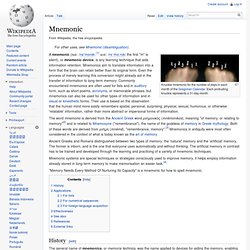
Each protruding knuckle represents a 31-day month. A mnemonic (RpE: /nəˈmɒnɨk/,[1] AmE: /nɛˈmɑːnɪk/ the first "m" is silent), or mnemonic device, is any learning technique that aids information retention. Mnemonics aim to translate information into a form that the brain can retain better than its original form. Even the process of merely learning this conversion might already aid in the transfer of information to long-term memory. Memetics. This article is related to the study of self-replicating units of culture, not to be confused with Mimesis.
Memetics is a theory of mental content based on an analogy with Darwinian evolution, originating from the popularization of Richard Dawkins' 1976 book The Selfish Gene.[1] Proponents describe memetics as an approach to evolutionary models of cultural information transfer. The meme, analogous to a gene, was conceived as a "unit of culture" (an idea, belief, pattern of behaviour, etc.) which is "hosted" in the minds of one or more individuals, and which can reproduce itself, thereby jumping from mind to mind.
Thus what would otherwise be regarded as one individual influencing another to adopt a belief is seen as an idea-replicator reproducing itself in a new host. As with genetics, particularly under a Dawkinsian interpretation, a meme's success may be due to its contribution to the effectiveness of its host. TOP TEN UNSOLVED PROBLEMS IN PHYSICS.