
Dictionaries. Word of the Day for November 19, 2010: rundlet. The Romantic Side of Familiar Words. Ten Most Difficult Words to Translate. Sometimes even the finest translators come up against words that defy translation.

Many languages include words that don’t have a simple counterpart in another language. When translators come across such a word, they usually describe it so that it makes sense in the target language. But some words pose more difficulty than others due to interesting cultural differences. Here are ten words that are particularly difficult to translate: Mamihlapinatapei From Yagan, the indigenous language of the Tierra del Fuego region of South America. Jayus From Indonesian, meaning a joke so poorly told and so unfunny that one cannot help but laugh.
Prozvonit In both Czech and Slovak language, this word means to call a mobile phone only to have it ring once so that the other person would call back, allowing the caller not to spend money on minutes. Kyoikumama In Japanese, this word refers to a mother who relentlessly pushes her children toward academic achievement. James while John had had had had had had had had had had had a better effect on the teacher. The example refers to two students, James and John, who are required by an English test to describe a man who, in the past, had suffered from a cold.
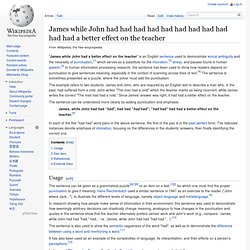
John writes "The man had a cold" which the teacher marks as being incorrect, while James writes the correct "The man had had a cold. " Since James' answer was right, it had had a better effect on the teacher. The sentence can be understood more clearly by adding punctuation and emphasis: James, while John had had "had", had had "had had"; "had had" had had a better effect on the teacher.[5] Usage[edit] The sentence can be given as a grammatical puzzle[6][7][8] or an item on a test,[1][2] for which one must find the proper punctuation to give it meaning. The sentence is also used to show the semantic vagueness of the word "had", as well as to demonstrate the difference between using a word and mentioning a word.[11] In the novel "Flowers for Algernon" written by Daniel Keyes, it was used as proof of intelligence.
See also[edit] References[edit] The plural of "octopus" is finally clarified. Words in English. A Brief History of English, with Chronologyby Suzanne Kemmer © 2001-2005 Pre-English | Old English | Middle English | Modern English The language we call English was first brought to the north sea coasts of England in the 5th and 6th centuries A.D., by seafaring people from Denmark and the northwestern coasts of present-day Germany and the Netherlands.

These immigrants spoke a cluster of related dialects falling within the Germanic branch of the Indo-European language family. Their language began to develop its own distinctive features in isolation from the continental Germanic languages, and by 600 A.D. had developed into what we call Old English or Anglo-Saxon, covering the territory of most of modern England. New waves of Germanic invaders and settlers came from Norway and Denmark starting in the late 8th century. The Norman Invasion and Conquest of 1066 was a cataclysmic event that brought new rulers and new cultural, social and linguistic influences to the British Isles.
In Jeopardy, Or, The Oddest English Spellings (Part 6) By Anatoly Liberman As though it is not enough that English vowels change all the time but are represented in spelling in the most archaic way imaginable, the language is swamped with French nouns, adjectives, and verbs, taken over in the Middle Ages and later.

In the new country, they have always felt perfectly comfortable (at home) and proved their patriotism by allowing their original vowels to merge with the indigenous crowd and shift when “the natives” did (and they shifted incessantly). But the educated class wanted the rest of the world to remember that it knew French and therefore retained the visual image of the borrowed words as it had been in the lending language. A passionate love of freedom went hand in hand with a voluntary subjugation not even to a message of a foreign culture (this would have been easy to understand), but to the envelope in which that message arrived.
Although we speak English (to the extent that we do), we spell in French half of the time.