
Inquisition. Brethren of the Free Spirit. The Brothers, or Brethren of the Free Spirit, was a lay Christian movement which flourished in northern Europe in the 13th and 14th centuries.
Antinomian and individualist in outlook, it came into conflict with the Catholic Church and was declared heretical by Pope Clement V at the Council of Vienne (1311–12). They are often considered similar to the Amalricians. Free love. Free love is a social movement that rejects marriage, which is seen as a form of social and financial bondage.
The Free Love movement's initial goal was to separate the state from sexual matters such as marriage, birth control, and adultery. It claimed that such issues were the concern of the people involved, and no one else.[1] Many people believe marriage is an important aspect of life to "fulfil earthly human happiness. " According to today's stereotype, earlier middle-class Americans wanted the home to be a place of stability in an uncertain world. To this mentality are attributed strongly defined gender roles, which led to a minority reaction in the form of the free love movement.[3] Bohemianism. This use of the word bohemian first appeared in the English language in the nineteenth century[1] to describe the non-traditional lifestyles of marginalized and impoverished artists, writers, journalists, musicians, and actors in major European cities.
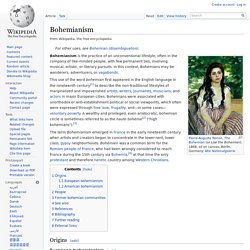
Bohemians were associated with unorthodox or anti-establishment political or social viewpoints, which often were expressed through free love, frugality, and—in some cases—voluntary poverty. A wealthy and privileged, even aristocratic, bohemian circle is sometimes referred to as the haute bohème[2] ("high bohemians").[3] The term Bohemianism emerged in France in the early nineteenth century when artists and creators began to concentrate in the lower-rent, lower class, gypsy neighborhoods. Bohémien was a common term for the Romani people of France, who had been wrongly considered to reach France during the 15th century via Bohemia,[4] at that time the only protestant and therefore heretic country among Western Christians.
Mithraic mysteries. Double-faced Mithraic relief.
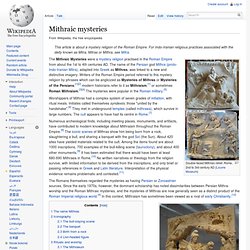
Rome, 2nd to 3rd century AD (Louvre Museum) The Mithraic Mysteries were a mystery religion practised in the Roman Empire from about the 1st to 4th centuries AD. The name of the Persian god Mithra (proto-Indo-Iranian Mitra), adapted into Greek as Mithras, was linked to a new and distinctive imagery. Writers of the Roman Empire period referred to this mystery religion by phrases which can be anglicized as Mysteries of Mithras or Mysteries of the Persians;[1][2] modern historians refer to it as Mithraism,[1] or sometimes Roman Mithraism.[3][4] The mysteries were popular in the Roman military.[5] The Romans themselves regarded the mysteries as having Persian or Zoroastrian sources.
Rock-born Mithras and Mithraic artifacts. The name Mithras[edit] Related deity-names in other languages include Iranian "Mithra" and Sanskrit "Mitra" are believed to come from an Indo-Iranian word mitra meaning "contract, agreement, covenant".[24] Eleusinian Mysteries. Votive plaque depicting elements of the Eleusinian Mysteries, discovered in the sanctuary at Eleusis (mid-4th century BC) The rites, ceremonies, and beliefs were kept secret and consistently preserved from a hoary antiquity.
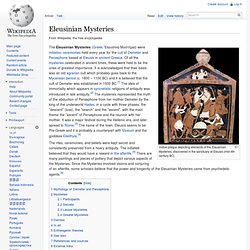
The initiated believed that they would have a reward in the afterlife.[5] There are many paintings and pieces of pottery that depict various aspects of the Mysteries. Dionysian Mysteries. The Dionysian Mysteries were a ritual of ancient Greece and Rome which used intoxicants and other trance-inducing techniques (like dance and music) to remove inhibitions and social constraints, liberating the individual to return to a natural state.
It also provided some liberation for those marginalized by Greek society: women, slaves and foreigners. In their final phase the Mysteries shifted their emphasis from a chthonic, underworld orientation to a transcendental, mystical one, with Dionysus changing his nature accordingly (similar to the change in the cult of Shiva). By its nature as a mystery religion reserved for the initiated, many aspects of the Dionysian cult remain unknown and were lost with the decline of Greco-Roman polytheism; our knowledge is derived from descriptions, imagery and cross-cultural studies. Origins[edit] Early Dionysus cult[edit] Role of wine[edit] Rites[edit] Emergence and evolution[edit] Male initiation rituals[edit] Female initiation rituals[edit]