
Future Tech. SEATS LIGHTBULB GRADO ZERO ESPACE. Grado Zero Espace 2013. Canadian scientists create a functioning, virtual brain. "Human's May be One of the Early Intelligent Species in the Universe" (Weekend Feature) Arthur C Clarke once wrote that a trillion years from now an advanced civilization will look back at us with envy and say "They knew the Universe when it was young.
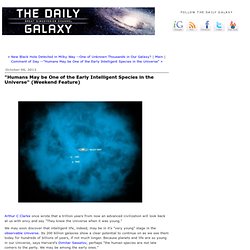
" We may soon discover that intelligent life, indeed, may be in it's "very young" stage in the observable Universe. Its 200 billion galaxies show a clear potential to continue on as we see them today for hundreds of billions of years, if not much longer. Because planets and life are so young in our Universe, says Harvard's Dimitar Sasselov, perhaps "the human species are not late comers to the party.
We may be among the early ones. " Scientist Creates Pizza Healthy Enough to Eat 3 Times a Day, Every Day. CA Governor Brown Signs SB1298 (Autonomous Vehicles) Methods. This Is Humanity’s Greatest Achievement, But Mainstream News Will Never Report It. Some day it’s entirely possible that the human race will be wiped out.
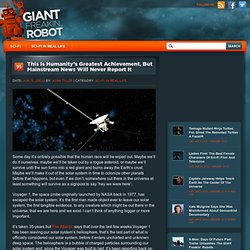
Maybe we’ll do it ourselves, maybe we’ll be taken out by a rogue asteroid, or maybe we’ll survive until the sun turns into a red giant and burns away the Earth’s crust. Maybe we’ll make it out of the solar system in time to colonize other planets before that happens, but even if we don’t, somewhere out there in the universe at least something will survive as a signpost to say “hey we were here”. Voyager 1, the space probe originally launched by NASA back in 1977, has escaped the solar system. It’s the first man made object ever to leave our solar system, the first tangible evidence, to any creature which might be out there in the universe, that we are here and we exist.
I can’t think of anything bigger or more important. Voyager 1 is now 11,100,000,000 miles away from the little blue dot called Earth, the only place in the universe where you can find an intelligent race called “humanity”. Man and robot linked by brain scanner. 5 July 2012Last updated at 08:55 ET The man-machine link was used to control a small humanoid robot Robot avatars have got a step closer to being the real world doubles of those who are paralysed or have locked-in-syndrome.
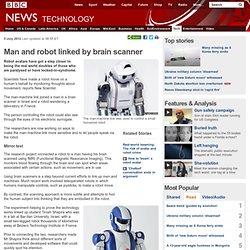
Scientists have made a robot move on a human's behalf by monitoring thoughts about movement, reports New Scientist. The man-machine link joined a man in a brain scanner in Israel and a robot wandering a laboratory in France. Space tech.
Powered exoskeletons. Biology. Plastic-eating fungi found in Amazon may solve landfill problems. NIF facility fires record laser shot into target chamber. (PhysOrg.com) -- The National Ignition Facility (NIF) at Lawrence Livermore National Laboratory in California has set a new record for a laser shot.
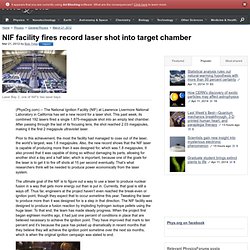
This past week, its combined 192 lasers fired a single 1.875-megajoule shot into an empty test chamber. After passing through the last of its focusing lens, the shot reached 2.03 megajoules, making it the first 2 megajoule ultraviolet laser. Prior to this achievement, the most the facility had managed to coax out of the laser, the world’s largest, was 1.6 megajoules. Also, the new record shows that the NIF laser is capable of producing more than it was designed for, which was 1.8 megajoules. It also proved that it was capable of doing so without damaging its parts, allowing for another shot a day and a half later, which is important, because one of the goals for the laser is to get it to fire off shots at 15 per second eventually. Explore further: Device turns flat surface into spherical antenna An official announcement is below: £200,000 test-tube burger marks milestone in future meat-eating.
Lab-grown burgers will be served up in October Link to video: Lab-grown burger to be served up in October Lurking in a petri dish in a laboratory in the Netherlands is an unlikely contender for the future of food.

The yellow-pink sliver the size of a corn plaster is the state-of-the-art in lab-grown meat, and a milestone on the path to the world's first burger made from stem cells. Dr Mark Post, head of physiology at Maastricht University, plans to unveil a complete burger – produced at a cost of more than £200,000 – this October. He hopes Heston Blumenthal, the chef and owner of the three Michelin-starred Fat Duck restaurant in Berkshire, will cook the offering for a celebrity taster as yet unnamed. The project, funded by a wealthy, anonymous, individual aims to slash the number of cattle farmed for food, and in doing so reduce one of the major contributors to greenhouse gas emissions. "You can easily calculate that we need alternatives. The recipe for meat grown in the lab.
Superhydrophobic spray means no more washing clothes – among others. Ross Technology Corp, a company that focuses on steel products has created a new product based on the spray known as NeverWet – which aside from being useful, is also pretty cool.

Now, this might not seem particularly interesting, but it has a myriad of applications; it is built from nanoparticles and it is hydrophobic – not only that it stops water from wetting it, but it shoots water right of from the surface on which it was applied. Even if at first they wanted to apply this technology to steel, they quickly realized the enormous list of applications this can have, from shoes and clothes that wouldn’t require washing any more, to your phone that could become waterproof, or just on stuff that you don’t want bacteria to get on.
This spray will be released as a commercial product next year. Check out this video to see exactly how it works. Spray an even coating on leather or fabric. Several neutrla people have tested the technology and report great results. A Brief Rant on the Future of Interaction Design. So, here's a Vision Of The Future that's popular right now.

It's a lot of this sort of thing. As it happens, designing Future Interfaces For The Future used to be my line of work. I had the opportunity to design with real working prototypes, not green screens and After Effects, so there certainly are some interactions in the video which I'm a little skeptical of, given that I've actually tried them and the animators presumably haven't. But that's not my problem with the video.
Terrafugia - Transition®, the Roadable Light Sport Aircraft : Home. Home - iCar 101 - The ultimate roadable aircraft. Skip to main content iCar 101 PoP Exclusive preview of iCar 101 PoP on Facebook Read all news. Future Timeline. Fear the Zippy Zapping Robo-Chopper. It’s a bird, it’s a plane … it’s a fast-flying stun-gunning robocopter?

You better believe it. The Shadowhawk is the latest development in automated grenade flinging – a remote controlled toy-sized helicopter that can record footage as easily as it can shoot a stun baton. You might spot the mini-drone zipping over the coast of East Africa looking out for pirates, or back at home helping the police hunt down criminals. Vanguard Defense, who spent three years developing this buzzing robot, sure packed a lot into the copter’s seven-foot, 50-lb frame. The Shadowhawk comes in five different varieties and can be outfitted with a turbine or piston engine, CCD TV optics, infrared and thermal cameras, laser pointers, illuminators and range finders.
Physicists Create a Working Transistor From a Single Atom. Australian and American physicists have built a working transistor from a single phosphorus atom embedded in a silicon crystal.
The group of physicists, based at the University of New South Wales and Purdue University, said they had laid the groundwork for a futuristic quantum computer that might one day function in a nanoscale world and would be orders of magnitude smaller and quicker than today’s silicon-based machines. In contrast to conventional computers that are based on transistors with distinct “on” and “off” or “1” and “0” states, quantum computers are built from devices called qubits that exploit the quirky properties of quantum mechanics. Unlike a transistor, a qubit can represent a multiplicity of values simultaneously. That might make it possible to factor large numbers more quickly than with conventional machines, thereby undermining modern data-scrambling systems that are the basis of electronic commerce and data privacy.
Dr.