
Japanese Beef Rolls with Ponzu. This is the second installment of Mizkan, Bringing Flavor to Life campaign on Rasa Malaysia.

(Please check out the Salmon Teriyaki recipe and the Mizkan landing page.) The featured recipe today is Japanese beef rolls and enoki mushroom with Ponzu sauce. One of the defining characteristics of Japanese cuisine is its emphasis on visual presentation, and this recipe delivers just that. This is often my go-to recipe whenever I have a party, or whenever I wish to impress my guests. These beef rolls are best served as an appetizer as your guests take in sips of wine and mingle around. This beef roll recipe is inspired by the popular beef tataki, or sliced seared beef prepared using the tataki cooking technique.
Two of the most important components of this recipe is the marinade and the serving sauce. Ponzu has become more common due to the increased popularity of Japanese cuisine. Do try out this Japanese beef rolls recipe. Chawanmushi Recipe (Japanese Steamed Egg Custard/茶碗蒸し. This is a special post to my readers who have requested for a chawanmushi recipe.
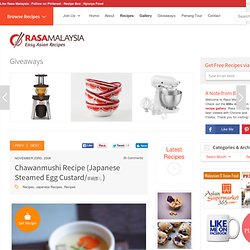
Chawanmushi or steamed egg custard (茶碗蒸し) is a popular Japanese dish, one that is mostly ordered as an appetizer at Japanese restaurants. From the name of this dish in Kanji 茶碗蒸, I believe chawanmushi is originally a Chinese dish, but has since been perfected by Japanese chefs. The Chinese version of steamed egg custard or 蒸水蛋 is a lot simpler, but not as tasty as chawanmushi, in my honest opinion. The reason is very simple: chawanmushi is loaded with treasures that are buried at the bottom of the steamed egg custard while the Chinese version is usually plain! Plus, the use of dashi stock and sake are great seasonings for an otherwise plain steamed egg taste. For my recipe, I used shrimp and chicken–two common ingredients for chawanmushi. All in all though, I love chawanmushi and made them two days in a row!
Other popular Japanese recipes on Rasa Malaysia:1. Japanese Recipes – Traditional Japanese dishes and modern Japanese cuisine. Chashu is a dish made of fattier cuts of pork that are braised over low heat for a very long time.

The low, slow cooking, renders out the fat while turning the tough collagen in the meat into gelatin which keeps the meat moist while making it meltingly tender. If you’re thinking the name sounds an awful lot like the Chinese barbecued pork dish Char Siu, you’d be right, because at some point in the past, they were one and the same. Chashu is often served atop another dish that also originated in China: ramen. Like its noodley brethren, it’s evolved over the past century to the point where it bears little resemblance to the original dish it was based on. In the hyper competitive world of ramen in Japan, each shop jealously guards its secret Chashu formula. The trick is to use pork cheek instead of the usual pork shoulder or belly that most people use for Chashu. For the braising liquid, I used a combination of soy sauce and miso. Japanese Tonkotsu Ramen Recipe From Scratch.
Making your own soup, noodles, and char siu, this recipe is either for the clinically insane, or the seriously hardcore foodie who misses good Japanese ramen.

I claim to be one of the latter, but I feel a little like one of the former. As I have been obsessed recently with hunting down ramen. The image to the left is from Naruto. And although ramen often makes an appearance in anime and manga, and is sometimes featured in them, this article doesn’t really have anything to do with either anime or manga. It’s just my craziness and I had to get it out of my system in the form of a blog post Actually, this recipe isn’t very difficult, but it IS time consuming. Notes: Unless you only have a small pot, I would double, triple, or quadruple this recipe because the stock freezes well and you’ll want to maximize on the results for the amount of time you spend on this recipe. Sometimes you might have seen the word “kotteri” (コッテリ) on a menu describing ramen. Ingredients (Serves 5) Soup: Notes: