
Edward Abbey. Edward Paul Abbey (January 29, 1927 – March 14, 1989) was an American author and essayist noted for his advocacy of environmental issues, criticism of public land policies, and anarchist political views. His best-known works include the novel The Monkey Wrench Gang, which has been cited as an inspiration by radical environmental groups, and the non-fiction work Desert Solitaire. Early life and education[edit] Abbey was born in Indiana, Pennsylvania on January 29, 1927 to Mildred Postlewait and Paul Revere Abbey. Mildred was a schoolteacher and a church organist, and gave Abbey an appreciation for classical music and literature.
Paul was a socialist, anarchist, and atheist whose views strongly influenced Abbey.[1] Abbey graduated from high school in Indiana, Pennsylvania, in 1945. In the military Abbey had applied for a clerk typist position but instead he served two years as a military police officer in Italy. When he returned to the United States, Abbey took advantage of the G.I. Henry David Thoreau. Henry David Thoreau (see name pronunciation; July 12, 1817 – May 6, 1862) was an American author, poet, philosopher, abolitionist, naturalist, tax resister, development critic, surveyor, and historian.
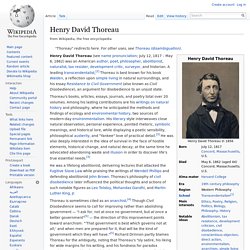
A leading transcendentalist,[2] Thoreau is best known for his book Walden, a reflection upon simple living in natural surroundings, and his essay Resistance to Civil Government (also known as Civil Disobedience), an argument for disobedience to an unjust state. Thoreau's books, articles, essays, journals, and poetry total over 20 volumes.
Among his lasting contributions are his writings on natural history and philosophy, where he anticipated the methods and findings of ecology and environmental history, two sources of modern-day environmentalism. Name pronunciation and physical appearance[edit] In appearance he was homely, with a nose that he called "my most prominent feature Life[edit] Early life and education, 1817–1836[edit] Return to Concord, 1836–1842[edit] Ralph Waldo Emerson. Ralph Waldo Emerson (May 25, 1803 – April 27, 1882) was an American essayist, lecturer, and poet, who led the Transcendentalist movement of the mid-19th century.
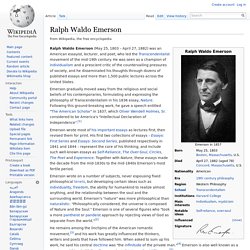
He was seen as a champion of individualism and a prescient critic of the countervailing pressures of society, and he disseminated his thoughts through dozens of published essays and more than 1,500 public lectures across the United States. He remains among the linchpins of the American romantic movement,[3] and his work has greatly influenced the thinkers, writers and poets that have followed him. When asked to sum up his work, he said his central doctrine was "the infinitude of the private man. "[4] Emerson is also well known as a mentor and friend of fellow Transcendentalist Henry David Thoreau.[5] Early life, family, and education[edit] Emerson was born in Boston, Massachusetts, on May 25, 1803,[6] son of Ruth Haskins and the Rev. In 1826, faced with poor health, Emerson went to seek out warmer climates. While in St. Connecticut Waterfalls. Connecticut Waterfalls - Roxbury Falls Statistics.