
Switzerland Virtual Jewish History Tour. [By: Avi Hein] Switzerland has had a settled Jewish community since the 13th century.

Today, the Jewish population of Switzerland is approximately 17,500 people - the tenth largest Jewish community in Europe. Tech's Best Feature: The Off Switch - Tiffany Shlain. It’s Friday evening.

The smells of rosemary chicken and freshly-baked challah fill the house. My daughters, 3 and 9, sigh as I gently detach the iPads from their laps. One by one, our screens are powered down. My husband, Ken, is usually the last holdout, in his office, madly scrambling to send out just one last email before the sun sets.
Then he unplugs too. Episode 1: Technology Shabbat. Living Wisdom. Sabbath Manifesto. The Four 4 Traditional Shofar Blasts. Chabad Switzerland. Blowing 2 shofars. Wroclaw synagogue. White Stork Synagogue. The synagoge at ul.

Pawła Włodkowica 7. A Synagogue for Spiritual Judaism. Blessings on Combination - Brachot Handbook. Whether eating a snack or a complete meal without bread, there are specific laws that apply to how the blessings are said on more than one food type.

When eating several different foods in the same category, say only one blessing. For example, when eating apples, oranges, and peaches, say only one blessing ha-aitz. The blessing is made over the preferred item, with the intention of including all foods of that category.When eating several foods from different categories, say a separate blessing over each type of food. For example: mezonot on crackers, ha-adamah on coleslaw, shehakol on eggs. Order Of Blessings: When one is eating foods requiring different blessings, the priority of the blessings is as follows: 1) mezonot; 2) ha-gafen; 3) ha-aitz; 4) ha-adamah; 5) shehakol. Two exceptions are: After saying the blessing borai pri hagafen over wine, additional blessings before and after other liquids or drinks are not necessary.
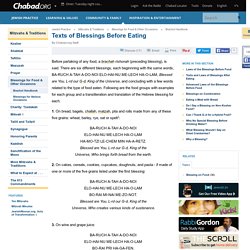
Blessings before Eating - Brachot Handbook. Before partaking of any food, a brachah rishonah (preceding blessing), is said.
Jewish Prayer: Daily Blessings over Foods. All graphics, commentary, and transliterations are © Copyright 1998, 2000, 2001, 2002 by Jordan Lee Wagner. placeholder We define a "meal" as: any eating that includes bread made from wheat, barley, rye, oats, or spelt.

Such an occasion requires ritual handwashing and a blessing ("motzi") beforehand, and reciting Birkat HaMazon (The Blessing for Sustenance; also called The Grace After Meals) afterwards. We define a "snack" as: any occasion of eating that does not require a handwashing and "motzi" beforehand and a "Birkat HaMazon" afterward. Different classes of food have different blessings that are recited before eating them. Ayinbeis.com. THE NEW FREEDOM SEDER, 2012: Occupy Holy Week/ Occupy Passover. SEE PHOTOS from April 1 in Philadelphia and in NYC!

Click here for PHL March and Freedom Seder and click here for NYC Occupy Passover/Occupy Holy Week albums on Facebook. First question: “Mah nishtanah haSeder hazeh miKol Sedarim? Why is this Seder different from all other Seders?” A prophetic voice in Jewish, multireligious, and American life. Elul - Inventory Season - Holiday. Elul, the last month of the Jewish year, is a time to review the past and look at where you’ve come in life.

It’s a preparation for the upcoming “Days of Awe”—Rosh Hashanah and Yom Kippur—when we resolve to do better this year than last. The theme of Elul is return to your essential self—a.k.a. teshuvah—helped along by prayer and charity. “The King is in the field,” they say, meaning that the G‑dly spark within you is much more accessible, as long as you search for it. Some key customs for the month of Elul: The shofar is a wake-up call to spiritually prepare for Rosh HashanahEach day (excepting Shabbat), a ram’s horn (called a shofar) is blown after the morning services. Rabbi Adin Steinsaltz: The Talmud as an Instruction Book. Elul Observances in a Nutshell - Guide. As the last month of the Jewish year, Elul is traditionally a time of introspection and stocktaking—a time to review one’s deeds and spiritual progress over the past year, and prepare for the upcoming “Days of Awe” of Rosh Hashanah and Yom Kippur.

As the month of divine mercy and forgiveness, Elul is a most opportune time for teshuvah (“return” to G‑d), prayer, charity, and increased ahavat Yisrael (love for a fellow Jew), in the quest for self-improvement and coming closer to G‑d. Chassidic master Rabbi Schneur Zalman of Liadi likens the month of Elul to a time when “the king is in the field” and, in contrast to when he is in the royal palace, “everyone who so desires is permitted to meet him, and he receives them all with a cheerful countenance, showing a smiling face to them all.”
The following are some of the basic customs and practices for the month of Elul: The Obsessions Collective. Hazon « Home « Jewish Inspiration. Sustainable Communities.