
Asteroid Exploration HAYABUSA (MUSES-C) / Missions. 25143 Itokawa. Discovery and naming[edit] The asteroid was discovered in 1998 by the LINEAR project and was given the provisional designation 1998 SF36. In August 2003,[4] it was officially named after Hideo Itokawa, a Japanese rocket scientist. Description[edit] Itokawa is an S-type asteroid. Radar imaging by Goldstone in 2001 observed an ellipsoid 630 ± 60 m long and 250 ± 30 m wide.[5][6] Itokawa's orbit This artist’s impression, based on detailed spacecraft observations, shows the strange peanut-shaped asteroid Itokawa. Exploration[edit] Surface features[edit] Names of major surface features were proposed by Hayabusa scientists and accepted by the Working Group for Planetary System Nomenclature of the International Astronomical Union. Craters[edit] Regiones[edit] Regiones (geologically distinct areas) on Itokawa. Analysis of particles reported in August 2011[edit] Schematic view of 25143 Itokawa[13] References[edit] Further reading[edit] External links[edit]
Hayabusa. Hayabusa (はやぶさ?
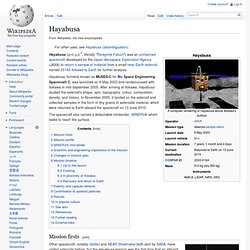
, literally "Peregrine Falcon") was an unmanned spacecraft developed by the Japan Aerospace Exploration Agency (JAXA) to return a sample of material from a small near-Earth asteroid named 25143 Itokawa to Earth for further analysis. The spacecraft also carried a detachable minilander, MINERVA, which failed to reach the surface. Mission firsts[edit] In addition, Hayabusa was the first spacecraft designed to deliberately land on an asteroid and then take off again (NEAR Shoemaker made a controlled descent to the surface of 433 Eros in 2000, but it was not designed as a lander and was eventually deactivated after it arrived). Technically, Hayabusa was not designed to "land"; it simply touches the surface with its sample capturing device and then moves away.
How mission Worked. The Great Challenges of "HAYABUSA" - World's first asteroid samp. Japanese Hayabusa Asteroid Mission Back On Earth. Japanese Hayabusa asteroid mission comes home BBC News- A capsule thought to contain the first samples grabbed from the surface of an asteroid has returned to Earth. The Japanese Hayabusa container hit the top of the atmosphere just after 1350 GMT, producing a bright fireball over southern Australia. Scientists are now searching the landing zone in the Woomera Prohibited Range to try to locate the capsule. It had a shield to cope with the heat of re-entry and a parachute for the final drop to the ground.
"We just had a spectacular display out over the Outback skies of South Australia," said Professor Trevor Ireland, from the Australian National University, who will get to work on the samples "We could see the little sample return capsule separate from the main ship and lead its way in and just had this magnificent display of the break-up of Hayabusa," he told BBC News. Even now, there is still some uncertainty as to whether the capsule really does contain pieces of Itokawa.
Reentry Video. Time Lapse. Want to stay on top of all the space news?
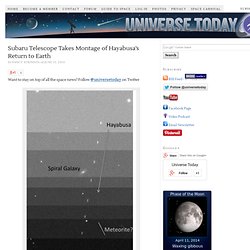
Follow @universetoday on Twitter The composite image from 11 images, each with 5 sec exposure, spaced by 35-50 sec. The magnitude of Hayabusa is estimated to be 21 mag. Credit: Subaru Telescope Team. Hayabusa Fireball. A sequence of images (screen grabs from the live coverage of the mission) showing the Hayabusa fireball as the spacecraft re-entered the atmosphere over Australia (JAXA/Ian O’Neill).
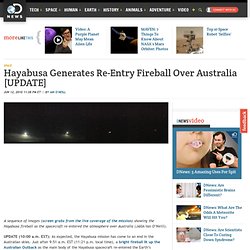
UPDATE (10:00 a.m. EST): As expected, the Hayabusa mission has come to an end in the Australian skies. Just after 9:51 a.m. Sequence of images showing #Hayabusa re-entry over Australia ... Drilling an Asteroid. Hayabusa Mission Video « Astronomy Article. Sciencearound.com Science DNA Sequencing Science Experiments Science Fiction. Hayabusa Sample Return Capsule Entry - Airborne Observing Campai. Hayabusa's Return. When news breaks in the world of astronomy, we try to get word of that to you here as quickly as possible.
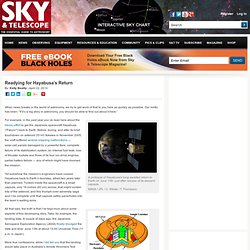
Our motto has been: “If it’s a big story in astronomy, you should be able to find out about it here.” For example, in the past year you’ve read here about the heroic effort to get the Japanese spacecraft Hayabusa ("Falcon") back to Earth. Before, during, and after its brief touchdown on asteroid 25143 Itokawa in November 2005, the craft suffered several crippling malfunctions — solar-cell panels damaged by a powerful flare, complete failure of its stabilization system, an internal fuel leak, loss of thruster rockets and three of its four ion-drive engines, partial battery failure — any of which might have doomed the mission. Yet somehow the mission’s engineers have coaxed Hayabusa back to Earth’s doorstep, albeit two years later than planned. All that said, the truth is that I’ve kept mum about some aspects of this developing story.
Chunk of Asteroid, Returns to Earth. A Japanese space capsule perhaps carrying the first ever sample from an asteroid is on track for a Sunday parachute landing in South Australia.
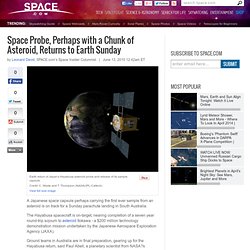
The Hayabusa spacecraft is on-target, nearing completion of a seven year round-trip sojourn to asteroid Itokawa - a $200 million technology demonstration mission undertaken by the Japanese Aerospace Exploration Agency (JAXA). Ground teams in Australia are in final preparation, gearing up for the Hayabusa return, said Paul Abell, a planetary scientist from NASA? S Johnson Space Center in Houston and a member of the Hayabusa Science Team and one of four individuals on a contingency ground recovery team. [Graphic: How Japan's Hayabusa Asteroid Mission Worked] ? Abell described the scene in Australia, with JAXA having roughly 60 people to help with the entire operation. ?
Woomera Prohibited Area Following its fireball fling with Earth? ? In Japan, the capsule is to find a home at JAXA? Asteroid Explorer "HAYABUSA" (MUSES-C) June 26, 2013 Updated Particles captured on asteroid Itokawa on exhibition.
NASA Helps Asteroid Mission. NASA Helps in Upcoming Asteroid Mission Homecoming The space and astronomy worlds have June 13 circled on the calendar.
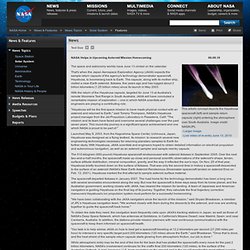
That's when the Japan Aerospace Exploration Agency (JAXA) expects the sample return capsule of the agency's technology demonstrator spacecraft, Hayabusa, to boomerang back to Earth. The capsule, along with its mother ship, visited a near-Earth asteroid, Itokawa, five years ago and has logged about 2 billion kilometers (1.25 billion miles) since its launch in May 2003. With the return of the Hayabusa capsule, targeted for June 13 at Australia's remote Woomera Test Range in South Australia, JAXA will have concluded a remarkable mission of exploration -- one in which NASA scientists and engineers are playing a contributing role. "Hayabusa will be the first space mission to have made physical contact with an asteroid and returned to Earth," said Tommy Thompson, NASA's Hayabusa project manager from the Jet Propulsion Laboratory in Pasadena, Calif. . Hayabusa NASA. Hayabusa Phase: Past Launch Date: May 09, 2003.

Asteroid Exploration. Hayabusa Sample Return Capsule Retrieved. Want to stay on top of all the space news?

Follow @universetoday on Twitter. Japanese Hayabusa probe returns from a tiny asteroid, 3 billion. The Japanese Hayabusa probe burned up in Earth's atmosphere on Sunday, but not before releasing the capsule that was the reason for its seven-year journey. Japan launched the Hayabusa (Japanese for peregrine falcon) probe back in 2003, aimed at a small near-earth asteroid named Itokawa.
The probe was designed to land on Itokawa, a mile-long bean-shaped asteroid, gather samples, and return home, which it did, this past weekend. That image above is of the probe burning up in our atmosphere--don't worry, that was part of the plan. Hayabusa Falls to Earth. Hayabusa falls to Earth, panels from probably the most poignant cartoon about a space-probe since XKCD's spirit cartoon.

Hayabusa, the little spacecraft that could, returned to earth on Sunday June 13. I've been following Hayabusa for some time, so it was a bit disappointing I forgot about its re-entry, but we were off bushwalking so I was distracted. The spacecraft itself was destroyed in the re-entry (and captured in the spectacular video below), but the asteroid sample return capsule was successfully retrieved and appears to be intact. Whether there is any asteroidal material in the sampler is unknown, the projectile that was supposed to kick up material to be sampled didn't work, but asteroids are fairly dusty things, and the simple impact of the sampler tube make have captured some material.
It will be a while before we know. Emily Lakdawalla has a good rundown of the return (with fantastic images) and further updates. Labels: asteroids, space probe, spacecraft. Epoch Times - Japanese Asteroid Probe Hayabusa Crash Lands on Ea. By Jack PhillipsEpoch Times Staff Created: June 14, 2010 Last Updated: June 15, 2010 This picture shows the asteroid Itokawa and its surface (R)JAXA/AFP/Getty Images (JAXA/AFP/Getty Images) The Japanese space probe Hayabusa re-entered the Earth's atmosphere and crashed in Woomera, in Australia's outback on Sunday.Hayabusa was launched back in 2003 by the Japan Aerospace Exploration Agency and traveled 3.1 million miles to collect asteroid samples from “a near-Earth asteroid” called Itokawa, NASA said.
NASA said that the entry of the probe back into the atmosphere created a massive fireball across the Australian sky, eventually crashing into the South Australian outback of the Woomera Prohibited Area, a military territory. Entering the atmosphere at more than 27,000 miles per hour with a temperature of 5,000 degrees Fahrenheit, the probe created a “breathtakingly beautiful” fireball, writes Ken Kremer for NASA. Scientists find asteroid probe, need can opener. Scientists have recovered part of a Japanese space probe that returned to Earth after landing on an asteroid to collect samples, and they're preparing to open it. At least The Andromeda Strain inspired them to wear helmets and body armor. After visiting asteroid, Hayabusa space capsule returns to Japan. Astronomy Picture of the Day. SETI Institute: Life at the SETI Institute: Meet Dr. Peter Jenni.