
Bloodstain Tutorial. The success or failure of any criminal investigation often depends on the recognition of physical evidence left at a crime scene and the proper analysis of that evidence.

Crime scenes that involve bloodshed often contain a wealth of information in the form of bloodstains. The pattern, size, shape, and the location of such stains may be very useful in the reconstruction of the events that occurred. William G. ECKERT and Stuart H. The Bloody Truth: How to Interpret Blood Spatters. Photo: Rod Englert Some people can’t stand the sight of blood.

Rod Englert is not one of those people. A detective with 45 years of investigative experience, Englert analyzes the Jackson Pollock-like spatters of hemoglobin and plasma at crime scenes. His new book, Blood Secrets, touts his biggest cases, and it’s also a handy manual for wannabe Dexters (minus the serial killing, we hope). Here’s a look at what those stains are trying to tell you. 1 Angular If the victim was on the move, drops hit at an angle. 2 High Velocity Misty, diffuse spatter is created by external force greater than 100 feet per second — which usually means a gunshot, an explosion, or (seriously) a sneeze. 3 Hair Impact A traumatic impact between head and surface tends to leave a stain with feathered edges, like someone squished a loaded paintbrush against the wall. 4 Hair Swipe If the smear fades out in one direction, the head was likely bloody before contact. 5 Fabric Swipe.
Test your bloodstain analysis skills - Image 1. Cookies on the New Scientist website close Our website uses cookies, which are small text files that are widely used in order to make websites work more effectively.

To continue using our website and consent to the use of cookies, click away from this box or click 'Close' Find out about our cookies and how to change them Test your bloodstain analysis skills 00:00 25 February 2009 Bloodstain analysts claim to be able to identify how a bloodstain was created simply by looking at it. Next Image 1 of 21 Question 1 How was this bloodstain created? All Galleries| Watch CSI: Crime Scene Investigation - Season 1 Episode 7: Blood Drops. Forensic Lighting : Crime Scene, Forensic Supplies. International Association of Bloodstain Pattern Analysts. Blood Stains. Collection and Preservation of Blood Evidence from Crime Scenes.
Printer Friendly Collection and Preservation ofBlood Evidence from Crime Scenes by George Schiro Forensic Scientist Louisiana State Police Crime Laboratory Preliminary Considerations Since blood evidence associated with a crime can provide information that may solve the case, it is essential to correctly document, collect, and preserve this type of evidence.

Communication is the key to effectively processing blood evidence. The technological state of blood evidence analysis has rapidly advanced in the last 20 years. ln the early seventies, most crime labs relied upon the ABO blood grouping system to characterize bloodstains. Currently, bloodstain analysis falls into three broad categories. Conventional serological analysis Analysis of the proteins, enzymes, and antigens present in the blood. Restriction Fragment Length Polymorphism (RFLP) DNA analysis Direct analysis of certain DNA sequences present in the white blood cells. Polymerase Chain Reaction (PCR) DNA analysis.
American Red Cross. Although all blood is made of the same basic elements, not all blood is alike.
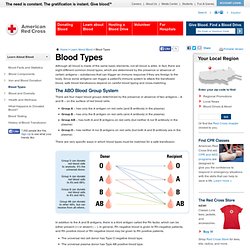
In fact, there are eight different common blood types, which are determined by the presence or absence of certain antigens – substances that can trigger an immune response if they are foreign to the body. Since some antigens can trigger a patient's immune system to attack the transfused blood, safe blood transfusions depend on careful blood typing and cross-matching. The Blood Typing Game - about blood groups, blood typing and blood transfusions. What happens if you get a blood transfusion with the wrong blood type?

Even though a patient's own blood type is the first choice for blood transfusions, it's not always available at the blood bank. Try to save some patients' lives and learn about human blood types! Play the Blood Typing Game About this game Embed the Blood Typing Game onto your own web site or blog Swedish version of the game 2012 Winner of the Best Game Category by Swedish Learning Awards "The winner has created a minimalistic but, at the same time, captivating graphic design which grabs the user's curiosity.