
Gottlieb Daimler. Gottlieb Wilhelm Daimler ( German pronunciation: [ˈɡɔtliːp ˈdaɪmlɐ] ; March 17, 1834 – March 6, 1900 [ 1 ] ) was an engineer , industrial designer and industrialist born in Schorndorf (Kingdom of Württemberg , a federal state of the German Confederation ), in what is now Germany.

He was a pioneer of internal-combustion engines and automobile development. He invented the high-speed petrol engine and the first four-wheel automobile. Daimler and his lifelong business partner Wilhelm Maybach were two inventors whose goal was to create small, high-speed engines to be mounted in any kind of locomotion device. In 1885 they designed a precursor of the modern petrol (gasoline) engine which they subsequently fitted to a two-wheeler, the first internal combustion motorcycle and, in the next year, to a stagecoach , and a boat.
Daimler baptized it the Grandfather Clock engine (Standuhr) because of its resemblance to an old pendulum clock. Early life: 1834-1852 [ edit ] Daimler later worked at Deutz. Georg Ohm. Georg Simon Ohm (German: [oːm]; 16 March 1789 – 6 July 1854) was a German physicist and mathematician.

As a high school teacher, Ohm began his research with the new electrochemical cell, invented by Italian scientist Alessandro Volta. Using equipment of his own creation, Ohm found that there is a direct proportionality between the potential difference (voltage) applied across a conductor and the resultant electric current. This relationship is known as Ohm's law. Kurt Tank. Kurt Waldemar Tank (February 24, 1898 – June 5, 1983) was a German aeronautical engineer and test pilot who led the design department at Focke-Wulf from 1931 to 1945.

He was responsible for the creation of several important Luftwaffe aircraft of World War II, including the Fw 190 fighter aircraft, the Ta 152 fighter-interceptor and the Fw 200 Condor airliner.[1][2] After the war, Tank spent two decades designing aircraft abroad, working first in Argentina and then in India, before returning to Germany in the late 1960s to work as a consultant for Messerschmitt-Bölkow-Blohm (MBB).[3] Gustav Kirchhoff. Gustav Robert Kirchhoff (12 March 1824 – 17 October 1887) was a German physicist who contributed to the fundamental understanding of electrical circuits, spectroscopy, and the emission of black-body radiation by heated objects.

Life and work[edit] Gustav Kirchhoff was born in Königsberg, East Prussia, the son of Friedrich Kirchhoff, a lawyer, and Johanna Henriette Wittke. He graduated from the Albertus University of Königsberg in 1847 where he attended the mathematico-physical seminar directed by Carl Gustav Jacob Jacobi,[1] Franz Ernst Neumann and Friedrich Julius Richelot. He married Clara Richelot, the daughter of his mathematics professor Richelot.
In the same year, they moved to Berlin, where he stayed until he received a professorship at Breslau. Daniel Best. Galileo Galilei. Galileo Galilei (Italian pronunciation: [ɡaliˈlɛːo ɡaliˈlɛi]; 15 February 1564[3] – 8 January 1642), often known mononymously as Galileo, was an Italian physicist, mathematician, engineer, astronomer, and philosopher who played a major role in the scientific revolution during the Renaissance.
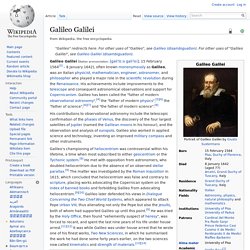
His achievements include improvements to the telescope and consequent astronomical observations and support for Copernicanism. Galileo has been called the "father of modern observational astronomy",[4] the "father of modern physics",[5][6] the "father of science",[6][7] and "the father of modern science".[8] Early life. Martinus Beijerinck. Albert Einstein. Albert Einstein (/ˈælbərt ˈaɪnʃtaɪn/; German: [ˈalbɐrt ˈaɪnʃtaɪn]; 14 March 1879 – 18 April 1955) was a German-born theoretical physicist.
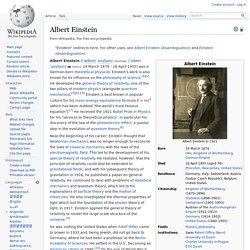
Einstein's work is also known for its influence on the philosophy of science.[4][5] He developed the general theory of relativity, one of the two pillars of modern physics (alongside quantum mechanics).[3][6]:274 Einstein is best known in popular culture for his mass–energy equivalence formula E = mc2 (which has been dubbed "the world's most famous equation").[7] He received the 1921 Nobel Prize in Physics for his "services to theoretical physics", in particular his discovery of the law of the photoelectric effect, a pivotal step in the evolution of quantum theory.[8] Near the beginning of his career, Einstein thought that Newtonian mechanics was no longer enough to reconcile the laws of classical mechanics with the laws of the electromagnetic field.
This led to the development of his special theory of relativity. Life Early life and education Death. Alexander Graham Bell. Alexander Graham Bell (March 3, 1847 – August 2, 1922)[4] was an eminent Scottish-born scientist, inventor, engineer and innovator who is credited with inventing the first practical telephone.
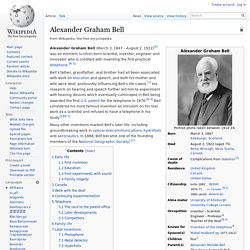
[N 3] Bell's father, grandfather, and brother had all been associated with work on elocution and speech, and both his mother and wife were deaf, profoundly influencing Bell's life's work.[7] His research on hearing and speech further led him to experiment with hearing devices which eventually culminated in Bell being awarded the first U.S. patent for the telephone in 1876. [N 4] Bell considered his most famous invention an intrusion on his real work as a scientist and refused to have a telephone in his study.[9][N 5] Many other inventions marked Bell's later life, including groundbreaking work in optical telecommunications, hydrofoils and aeronautics.