
Reptile. The earliest known reptiles originated around 315 million years ago during the Carboniferous period, having evolved from advanced reptile-like amphibians that became increasingly adapted to life on dry land.
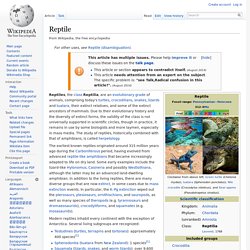
Some early examples include the lizard-like Hylonomus, Casineria and possibly Westlothiana, although the latter may be an advanced land-dwelling amphibian. In addition to the living reptiles, there are many diverse groups that are now extinct, in some cases due to mass extinction events. In particular, the K–Pg extinction wiped out the pterosaurs, plesiosaurs, ornithischians, and sauropods, as well as many species of theropods (e.g. tyrannosaurs and dromaeosaurids), crocodyliforms, and squamates (e.g. mosasaurids). Modern reptiles inhabit every continent with the exception of Antarctica. Several living subgroups are recognized: Reptiles are tetrapod vertebrates, creatures that either have four limbs or, like snakes, being descended from four-limbed ancestors. Classification[edit]
Crocodilia. Large, solidly built, lizard-like reptiles, crocodilians have long flattened snouts, laterally compressed tails, and eyes, ears, and nostrils at the top of the head.
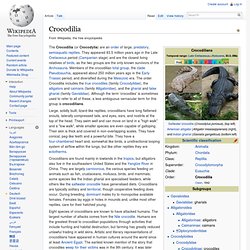
They swim well and can move on land in a "high walk" and a "low walk", while smaller species are even capable of galloping. Their skin is thick and covered in non-overlapping scales. They have conical, peg-like teeth and a powerful bite. They have a four-chambered heart and, somewhat like birds, a unidirectional looping system of airflow within the lungs, but like other reptiles they are ectotherms. Eight species of crocodilians are known to have attacked humans. Spelling and etymology[edit] The group is often spelled 'Crocodylia' for consistency with the genus Crocodylus (Laurenti, 1768). Morphology and physiology[edit] Mounted skeleton and taxidermy of Nile crocodile Crocodilians, like this spectacled caiman, can hide in water with only their nostrils, eyes and ears at the surface.
Locomotion[edit] Jaws and teeth[edit] Alligator. An alligator is a crocodilian in the genus Alligator of the family Alligatoridae.

The two living species are the American alligator (A. mississippiensis) and the Chinese alligator (A. sinensis). In addition, several extinct species of alligator are known from fossil remains. Alligators first appeared during the Oligocene epoch about 37 million years ago.[1] The name "alligator" is probably an anglicized form of el lagarto, the Spanish term for "the lizard", which early Spanish explorers and settlers in Florida called the alligator.
Later English spellings of the name included allagarta and alagarto.[2] Species (extant) Description A typical adult American alligator's weight and length is 360 kg (790 lb) and 4.0 m (13.1 ft), but they sometimes grow to 4.4 m (14 ft) long and weigh over 450 kg (990 lb).[3] The largest ever recorded, found in Louisiana, measured 5.84 m (19.2 ft).[4] The Chinese alligator is smaller, rarely exceeding 2.1 m (6.9 ft) in length.
Habitat Head of A, mississippiensis. Crocodile. Etymology The word "crocodile" comes from the Ancient Greek κροκόδιλος (crocodilos), "lizard," used in the phrase ho krokódilos tou potamoú, "the lizard of the (Nile) river".
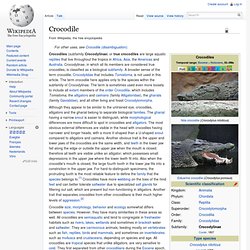
There are several variant Greek forms of the word attested, including the later form κροκόδειλος (crocodeilos)[4] found cited in many English reference works.[5] In the Koine Greek of Roman times, crocodilos and crocodeilos would have been pronounced identically, and either or both may be the source of the Latinized form crocodīlus used by the ancient Romans.
Crocodilos or crocodeilos is a compound of krokè ("pebbles"), and drilos/dreilos ("worm"), although drilos is only attested as a colloquial term for "penis".[5] It is ascribed to Herodotus, and supposedly describes the basking habits of the Egyptian crocodile.[6] Species Distribution of crocodiles A total of 14 extant species have been recognized. Characteristics Crocodiles, like dinosaurs, have the abdominal ribs modified into gastralia. Size Teeth Senses Vision Touch.