
Precambrian. Positions of landmasses near the end of the Precambrian Overview[edit] Relatively little is known about the Precambrian, despite its making up roughly seven-eighths of the Earth's history, and what is known has largely been discovered in the past 50 years.

The Precambrian fossil record is poorer than that of the succeeding Phanerozoic, and those fossils present (e.g. stromatolites) are of limited biostratigraphic use.[1] This is because many Precambrian rocks are heavily metamorphosed, obscuring their origins, while others have either been destroyed by erosion, or remain deeply buried beneath Phanerozoic strata.[1][2] It is thought that the Earth itself coalesced from material in orbit around the Sun roughly 4500 Ma, or 4.5 billion years ago (Ga), and may have been struck by a very large (Mars-sized) planetesimal shortly after it formed, splitting off material that came together to form the Moon (see Giant impact hypothesis).
Life before the Cambrian[edit] Subdivisions[edit] See also[edit] Trilobite. Trilobites had many life styles; some moved over the sea-bed as predators, scavengers or filter feeders and some swam, feeding on plankton.
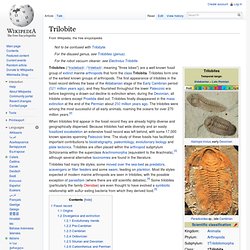
Most life styles expected of modern marine arthropods are seen in trilobites, with the possible exception of parasitism (where there are still scientific debates).[4] Some trilobites (particularly the family Olenidae) are even thought to have evolved a symbiotic relationship with sulfur-eating bacteria from which they derived food.[5] Fossil record[edit] All Olenellina lack facial sutures (see below), and this is thought to represent the original state. The earliest sutured trilobite found so far (Lemdadella), occurs almost at the same time as the earliest Olenellina however, implying that trilobite origin lies before the start of the Atdabanian, but without leaving fossils.[6] Other groups show secondary lost facial sutures, such as all Agnostina and some Phacopina.
Origins[edit] Divergence and extinction[edit] Evolutionary trends[edit] Bacteria. Bacteria ( Most bacteria have not been characterised, and only about half of the bacterial phyla have species that can be grown in the laboratory.[10] The study of bacteria is known as bacteriology, a branch of microbiology.
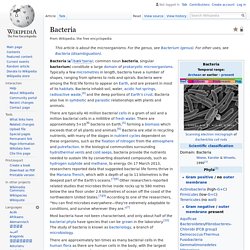
Etymology Origin and early evolution Morphology Many bacterial species exist simply as single cells, others associate in characteristic patterns: Neisseria form diploids (pairs), Streptococcus form chains, and Staphylococcus group together in "bunch of grapes" clusters. Even more complex morphological changes are sometimes possible. Cellular structure Structure and contents of a typical gram-positive bacterial cell (seen by the fact that only one cell membrane is present). Intracellular structures The bacterial cell is surrounded by a cell membrane (also known as a lipid, cytoplasmic or plasma membrane).
Many important biochemical reactions, such as energy generation, use concentration gradients across membranes. Extracellular structures Endospores Growth and reproduction. Cyanobacteria. By producing oxygen as a gas as a by-product of photosynthesis, cyanobacteria are thought to have converted the early reducing atmosphere into an oxidizing one, which dramatically changed the composition of life forms on Earth by stimulating biodiversity and leading to the near-extinction of oxygen-intolerant organisms.
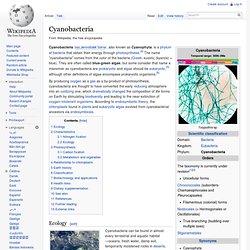
According to endosymbiotic theory, the chloroplasts found in plants and eukaryotic algae evolved from cyanobacterial ancestors via endosymbiosis. Ecology[edit] A cyanobacteria bloom near Fiji Aquatic cyanobacteria are known for their extensive and highly visible blooms that can form in both freshwater and marine environments. The blooms can have the appearance of blue-green paint or scum. Characteristics[edit] Cyanobacteria are a photosynthetic nitrogen fixing group that survive in wide variety of habitat, soil and water. Nitrogen fixation[edit] Cyanobacteria are arguably the most successful group of microorganisms on earth.