
Reporters Sans Frontières - Wikileaks hounded? Reporters Without Borders condemns the blocking, cyber-attacks and political pressure being directed at cablegate.wikileaks.org, the website dedicated to the US diplomatic cables.
The organization is also concerned by some of the extreme comments made by American authorities concerning WikiLeaks and its founder Julian Assange. Earlier this week, after the publishing several hundred of the 250.000 cables it says it has in its possession, WikiLeaks had to move its site from its servers in Sweden to servers in the United States controlled by online retailer Amazon.
Amazon quickly came under pressure to stop hosting WikiLeaks from the Senate Committee on Homeland Security and its chairman, Sen. 12 Theses on Wikileaks. These 0.
WikiLeaks, une vérité insoutenable ? “Une société transparente est une société totalitaire” F.
Baroin (à propos de WikiLeaks) le 29.11.2010 Aucune “révélation” fracassante, rien qui ne peut ébranler le monde. Pourtant WikiLeaks a frappé le cœur du système. Il a rapporté les petites phrases diplomatiques des uns sur les autres, un gossip mondial qui expose finalement ce qui se savait ou se subodorait déjà. En substance, que la diplomatie bruisse de petites phrases, s’arrange de coups tordus, d’avis plus ou moins autorisés forcément subjectifs sur un chef d’État ou un pays.
Les messages diplomatiques mis en ligne sont le fruit d’un vol. L’incursion de WikiLeaks produit un choc dans ce milieu tempéré par les mandarins omnipotents. Plus de ligne éditoriale, de joug politique dont les injonctions font taire les dossiers. Atteinte à la démocratie, dictature de la transparence, la levée de boucliers est immédiate. Agiter le spectre de l’homme nu, sans intimité relève d’une confondante mauvaise foi.
Il ne s’est rien passé. 2010-12-04: NSW Supreme Court Solicitor Peter Kemp: Letter to Australian Prime Minister Julia Gillard. By Peter Kemp, Solicitor of the Supreme Court of New South Wales, on 2010-12-04 Dear Prime Minister From the Sydney Morning Herald I note you made a comment of "illegal" on the matter of Mr Assange in relation to the ongoing leaks of US diplomatic cables.
Previously your colleague and Attorney General the Honourable McClelland announced an investigation of possible criminality by Mr Assange. As a lawyer and citizen I find this most disturbing, particularly so when a brief perusal of the Commonwealth Criminal Code shows that liability arises under the Espionage provisions, for example, only when it is the Commonwealth's "secrets" that are disclosed and that there must be intent to damage the Commonwealth. Likewise under Treason law, there must be an intent to assist an enemy. Those offences remain unclear and the Swedish prosecutor Ms Ny appears to be making up the law as she wants.
An Australian citizen is apparently being singled out for "special treatment" Prime Minister. Augmentons nos démocraties de quelques lignes de code » Article » OWNI, Digital Journalism. Overseeing state secrecy: In defence of WikiLeaks. The Shameful Attacks on Julian Assange - David Samuels - International. Getty Images Julian Assange and Pfc Bradley Manning have done a huge public service by making hundreds of thousands of classified U.S. government documents available on Wikileaks -- and, predictably, no one is grateful.
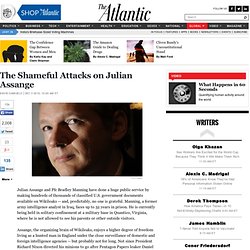
Manning, a former army intelligence analyst in Iraq, faces up to 52 years in prison. Wikileaks et la révolte du clergé » Article » OWNI, Digital Journalism. Éric Scherer fustige les réactions hostiles à WikiLeaks d'une partie des médias traditionnels.
Face à ce nouveau venu qui bouscule encore un peu plus les anciennes pratiques du métier, il est urgent d'évoluer. Wetting our WikiLeaks whistle. Assange The Oz - Don't shoot messenger. Elizabeth Cook's artist impression of WikiLeaks founder Julian Assange's appearance at Westminster Magistrates Court in London, where he was denied bail after appearing on an extradition warrant.
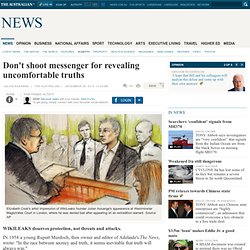
Source: AP WIKILEAKS deserves protection, not threats and attacks. IN 1958 a young Rupert Murdoch, then owner and editor of Adelaide's The News, wrote: "In the race between secrecy and truth, it seems inevitable that truth will always win. " His observation perhaps reflected his father Keith Murdoch's expose that Australian troops were being needlessly sacrificed by incompetent British commanders on the shores of Gallipoli. The British tried to shut him up but Keith Murdoch would not be silenced and his efforts led to the termination of the disastrous Gallipoli campaign.
Why WikiLeaks’ latest document dump makes everyone in journalism — and the public — a winner. For some, WikiLeaks’ recent dump of diplomatic cables seems to make an excellent case for why traditional journalism still matters.
Others, however, suggest that the widespread condemnation of WikiLeaks founder Julian Assange is a sign of a toothless legacy media that can’t do its own work — and a triumph for new forms of journalism. The truth is, though, that everyone here is a winner — traditional media and non-traditional journalism and, most importantly, the public. The Blueprint. With every day, with every passing hour, the power of the state mobilizes against Wikileaks and Julian Assange, its titular leader.
The inner processes of statecraft have never been so completely exposed as they have been in the last week. The nation state has been revealed as some sort of long-running and unintentionally comic soap opera. WikiLeaks a blueprint for things to come - Unleashed. Find More Stories.