
The “no self-defeating object” argument. A fundamental tool in any mathematician’s toolkit is that of reductio ad absurdum: showing that a statement is false by assuming first that is true, and showing that this leads to a logical contradiction.
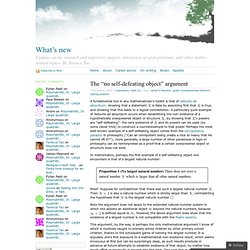
A particulary pure example of reductio ad absurdum occurs when establishing the non-existence of a hypothetically overpowered object or structure. The “no self-defeating object” argument, and the vagueness paradox. The “no self-defeating object” argument, revisited. One notable feature of mathematical reasoning is the reliance on counterfactual thinking – taking a hypothesis (or set of hypotheses) which may or may not be true, and following it (or them) to its logical conclusion.

For instance, most propositions in mathematics start with a set of hypotheses (e.g. “Let be a natural number such that …”), which may or may not apply to the particular value of one may have in mind. Or, if one ever argues by dividing into separate cases (e.g. Is even. … Case 2: is odd. …”), then for any given , at most one of these cases would actually be applicable, with the other cases being counterfactual alternatives. Is equal to the ratio of two natural numbers.”), and proceeds to demonstrate this fact by showing that this hypothesis leads to absurdity. Lecturer: “Theorem. Or Lecturer: “Now we see what the function does when we give it the input of instead. …”Student: “But didn’t you just say that the input was equal to just a moment ago?”
Proposition 1′. Proof. ) . – 1. Kurt Gödel's Ontological Argument. Kurt Gödel is best known to mathematicians and the general public for his celebrated incompleteness theorems.
Physicists also know his famous cosmological model in which time-like lines close back on themselves so that the distance past and the distant future are one and the same. What is less well known is the fact that Gödel has sketched a revised version of Anselm's traditional ontological argument for the existence of God. How does a mathematician get mixed up in the God-business? Gödel was a mystic, whose mathematical research exemplified a philosophical stance akin to the Neo-Platonics. In this respect, Gödel had as much in common with the medieval theologians and philosophers as the twentieth-century mathematicians who pioneered the theory of computation and modern computer science.
Talking about proof theory often feels like discourse about God: When you talk about God, you have to discuss issues like "if God created the Universe, then who created God? " Intuitionistic mathematics for physics « Mathematics and Computation. At MSFP 2008 in Iceland I chatted with Dan Piponi about physics and intuitionistic mathematics, and he encouraged me to write down some of the ideas.
I have little, if anything, original to say, so this seems like an excellent opportunity for a blog post. So let me explain why I think intuitionistic mathematics is good for physics. Intuitionistic mathematics, whose main proponent was L.E.J. Brouwer, is largely misunderstood by mathematicians. Consequently, physicists have strange ideas about it, too. While Brouwer’s and other preintuitionists’ reasons for intuitionistic mathematics were philosophical in nature, there is today a vibrant community of mathematicians, logicians, computer scientists, and even the odd physicist, who work with intuitionistic mathematics not because of their philosophical conviction but because it is simply the right kind of math for what they are doing.
How to solve the hardest logic puzzle ever in two questions. Rabern and Rabern (2008) have noted the need to modify ‘the hardest logic puzzle ever’ as presented in Boolos 1996 in order to avoid trivialization.
Their paper ends with a two-question solution to the original puzzle, which does not carry over to the amended puzzle. The purpose of this note is to offer a two-question solution to the latter puzzle, which is, after all, the one with a claim to being the hardest logic puzzle ever. Recall, first, Boolos's statement of the puzzle: Three gods A, B and C are called, in some order, True, False and Random. True always speaks truly, False always speaks falsely, but whether Random speaks truly or falsely is a completely random matter. Your task is to determine the identities of A, B and C by asking three yes-no questions; each question must be put to exactly one god.
It could be that some god gets asked more than one question. Is the “Hardest Logic Puzzle Ever” too Easy? In 1992, the philosopher George Boolos gave what he called the “Hardest Logic Puzzle Ever”, which he attributed to Raymond Smullyan.
In 2008, a clever paper by two graduate students, Brian Rabern and Landon Rabern, appeared in the philosophical journal “Analysis” which gave a simpler solution to the puzzle than Boolos gave—and furthermore claimed that a solution to a stronger puzzle was possible! As its name implies, the “Hardest Logic Puzzle Ever” has a number of complicating factors which will be irrelevant for this discussion. Instead, consider the following much simpler puzzle which will do just as well.
You are on an island populated by knights and knaves. Knights always tell the truth; knaves always lie.