
How to be gay. “Some days, I really just needed to curl up in a cozy plaid jacket and have all the homo feelings.”

You want to touch them, smell them and, if you’re me, bite their ear. Why don’t the forces of geography and physics rally to both your cries and fold the world up like origami until the front doors of your homes kiss? Where to go and what to do when you want to ditch that vibrator and find a good helping hand. MEN'S VOICES, MEN AS ALLIES: Starting to Define Healthy Masculinity by Patrick McGann. Best Feminist Books (628 books)
Sex-critical feminism (14 books) Let's Talk About Thin Privilege. This originally appeared on Everyday Feminism.
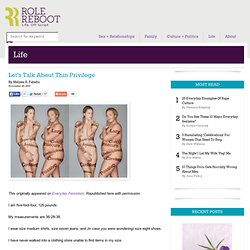
Republished here with permission. I am five-foot-four, 125 pounds. My measurements are 36-28-38. I wear size medium shirts, size seven jeans, and (in case you were wondering) size eight shoes. I have never walked into a clothing store unable to find items in my size. I have never been asked to pay more for a seat on an airplane. I have never had someone dismiss me as a dating prospect based on my body type, nor had someone scoff, openly, while watching me eat French fries in public.
I have never experienced a doctor dismissing my concerns with a “lose weight, feel great!” And I can open an article with my measurements without fear of judgment. ▶ BBC One - Doctor Who, The Day of the Doctor, The Five(ish) Doctors Reboot. BBC Religion & Ethics - Doctor Who: Time travel through faith. 22 November 2013Last updated at 10:06 Doctor Who has continually engaged with important religious and ethical themes for 50 years As Doctor Who fans celebrate the series's 50th anniversary Dr Andrew Crome, lecturer in the history of modern Christianity at the University of Manchester, explains how the time-travelling Doctor allows us to explore different beliefs and ethical viewpoints.

A near immortal crossing space and time, followers split over interpretation, characters in strange hats... Perhaps it is no surprise Doctor Who is sometimes described as a form of surrogate religion. However, behind this light-hearted comparison lies a grain of truth, as Doctor Who has continually engaged with important religious themes across its 50-year run. Lovecraftian Books. 30 Quick Tips That Will Help You Get Where You Want In Life. 1.

Be compelling. 2. Take everything that anyone else might call a fault and find the silver lining. 3. Black Phoenix Alchemy Lab. And now, for the third time, Garm, the hound with blood upon his jaws, barked.
He had broken loose on the world, and with fierce bounds he rushed toward Vigard Plain, where the Gods had assembled their powers. Loud barked Garm. Bob Ross vs Pablo Picasso - Epic Rap Battles of History Season 3.
Things to do at knox. Ashes Over England: The Clitorighteous Story. Stuff. Fandom. Useful shit. SCIENCE. New Age Stuffs. Free Books. Pretty Things. Quotes and Inspiration. Things That I Should Totally Do. SEX. Humor. Top 10 Song Mashups. After you’ve listened to a song often enough that you can sing the whole thing karaoke –style without a screen assist (and make it even more embarrassing when you screw it up), you can either move on to new music or try to approach it in a new way.

22 Things Celebrities Did At Comic Con. Bellanut: I call this one The Ginormous Frown Face. I actually find it a bit frightening, and I'm pretty sure that if you stare at it for too long there's a risk of slipping in to a lip-induced trance. So view with caution. This one is also a perfect example of why I sometimes refer to Jensen as Gumby Face in my head. Silk – Interactive Generative Art. Forms of Poetry - Types of Poetry. Cinquain. The cinquain, also known as a quintain or quintet, is a poem or stanza composed of five lines.
Examples of cinquains can be found in many European languages, and the origin of the form dates back to medieval French poetry. Terzanelle. Ghazal. The ghazal is composed of a minimum of five couplets—and typically no more than fifteen—that are structurally, thematically, and emotionally autonomous.
Dunadh. Tanka. The Japanese tanka is a thirty-one-syllable poem, traditionally written in a single unbroken line.
A form of waka, Japanese song or verse, tanka translates as "short song," and is better known in its five-line, 5/7/5/7/7 syllable count form. One of the oldest Japanese forms, tanka originated in the seventh century, and quickly became the preferred verse form not only in the Japanese Imperial Court, where nobles competed in tanka contests, but for women and men engaged in courtship. Renga. Renga, meaning "linked poem," began over seven hundred years ago in Japan to encourage the collaborative composition of poems.
Poets worked in pairs or small groups, taking turns composing the alternating three-line and two-line stanzas. Villanelle. Sestina. The sestina is a complex form that achieves its often spectacular effects through intricate repetition. The thirty-nine-line form is attributed to Arnaut Daniel, the Provencal troubadour of the twelfth century. Strambotto (Tuscan) Pantoum. The pantoum originated in Malaysia in the fifteenth-century as a short folk poem, typically made up of two rhyming couplets that were recited or sung. However, as the pantoum spread, and Western writers altered and adapted the form, the importance of rhyming and brevity diminished.
The modern pantoum is a poem of any length, composed of four-line stanzas in which the second and fourth lines of each stanza serve as the first and third lines of the next stanza. The last line of a pantoum is often the same as the first. The pantoum was especially popular with French and British writers in the nineteenth-century, including Charles Baudelaire and Victor Hugo, who is credited with introducing the form to European writers.
The pantoum gained popularity among contemporary American writers such as Anne Waldman and Donald Justice after John Ashbery published the form in his 1956 book, Some Trees. Sapphic. The sapphic dates back to ancient Greece and is named for the poet Sappho, who left behind many poem fragments written in an unmistakable meter. Sapphics are made up of any number of four-line stanzas, and many Greek and Roman poets, including Catullus, used the form. It was introduced to Roman and European poets by Horace, who frequently used sapphics in his Odes, and later became popular as a verse form for hymns during the Middle Ages. Modern sapphics have been written by Ezra Pound, John Frederick Nims, and Anne Carson.
The original sapphic form was determined by quantitative meter, based on the nature of the ancient Greek language in which syllables were either long or short, depending on vowel length and ending sound. However, modern sapphics are rendered in accentual meter determined instead by the stress and intensity of a syllable.