
20070903-leuven2005. The training measurement book: best ... - Josh Bersin. Seven_KeyLearningIndicators. Scribd. Measuring ROI of Training. Measuring training effectiveness - Toolbox for HR Groups. Joyce, There are two measures which you need to consider: OJT Measures: Which means how much productivity the employee delivers after training.
Behavioural Measures: Is the team or leader or Manager delivering better after training. And what are the results expected? Conceptual Measures: How many concepts have been converted to reality? As a start, you need to do a GAP ANALYSES! Is training always a solution? Sometimes, the folks need psychiatry! I have the modules you want, but this is based on the BALANCED SCORECARD SYSTEM. Finally, my DASHBOARD is customizable, easily readable and therefore understandable. In case you have my kind of bread, my email ID is email@removed. I wish you good luck! Measuring Training Effectiveness - HRPeople. News >> Browse Articles >> General News News >> Browse Articles >> HR News Featured Author: Benifys Benifys took shape with a view to provide cost effective, quality HR solutions to partner organizations.
We believe strongly that HR can add value to any organization – irrespective of size, industry vertical, nature of operations or geography. Delivering a training program is not enough, the cycle does not end there. The need to measure training effectiveness To gauge the effectiveness of the current ongoing training programs in an organizationTo identify gaps in training output and use the information to improve the training initiativesTo evaluate whether the budget allocated for the training activity is justified, and whether the program has a good ROI.
Donald Kirkpatrick and his Four Level evaluation model According to Kirkpatrick, each one of these four levels is equally important and every level has an impact on the next level. The Corporate Learning Factbook 2011 Benchmarks, Trends and Analysis of the U.S. Training Market. Sullivan: Training Metrics. Communication methods supporting design processes. Business Best Practices & Best Practice Benchmarking. Business best practices, as defined by The Hackett Group, are proven, repeatable, documented techniques that deliver measurable business performance management improvements.

Executives look to business best practices benchmarking to help them speed their progress toward enterprise performance management improvement, and to guide them around pitfalls that might otherwise slow or even halt their initiatives. What makes Hackett's business best practices unique is the reliability and depth of the documentation behind them. Business best practices that Hackett measures become "certified" when we can empirically document a correlation with the ability to achieve world-class performance. Our performance optimization standard of "world-class" describes organizations that achieved top-quartile performance in both effectiveness and efficiency. Evaluating Training Effectiveness.
Why Measure Training Effectiveness?
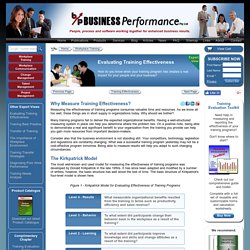
Measuring the effectiveness of training programs consumes valuable time and resources. As we know all too well, these things are in short supply in organizations today. Why should we bother? Many training programs fail to deliver the expected organizational benefits. Having a well-structured measuring system in place can help you determine where the problem lies. Consider also that the business environment is not standing still. The Kirkpatrick Model The most well-known and used model for measuring the effectiveness of training programs was developed by Donald Kirkpatrick in the late 1950s. Figure 1 - Kirkpatrick Model for Evaluating Effectiveness of Training Programs What measurable organizational benefits resulted from the training in terms such as productivity, efficiency and sales revenue?
An evaluation at each level answers whether a fundamental requirement of the training program was met.