
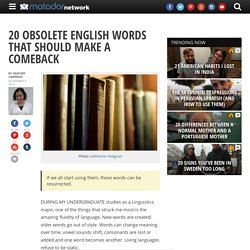
Atlas of True Names. Expand your vocabulary! Confusing Words. Random Word Generator (Plus) Word Spy. 20 obsolete English words that should make a comeback. Photo: Katherine Hodgson If we all start using them, these words can be resurrected.
DURING MY UNDERGRADUATE studies as a Linguistics major, one of the things that struck me most is the amazing fluidity of language. New words are created; older words go out of style. Words can change meaning over time, vowel sounds shift, consonants are lost or added and one word becomes another. Living languages refuse to be static. The following words have sadly disappeared from modern English, but it’s easy to see how they could be incorporated into everyday conversation. Words are from Erin McKean’s two-volume series: Weird and Wonderful Words and Totally Weird and Wonderful Words. 1. Verb trans. – “To confuse, jumble” – First of all this word is just fun to say in its various forms. 2. 3. Verb trans. – “To scrape together; to gather together from various sources” – I’m sure this wasn’t the original meaning of the word, but when I read the definition I immediately thought of copy-pasting. 4. 5. 6.
Randomly Awesome Words. The Dictionary of Obscure Sorrows. Unusual Words. Unusual Words A by no means exhaustive list of rare, obscure, strange and sometimes funny words and their meanings that only seem to crop up in crosswords and dictionaries. Words that are used so seldom, you wonder who invented them and why.
"53 Slang Terms by Decade" Internet Anagram Server. The 100 Most Beautiful Words in English. Ere are the 100 most beautiful words in English.
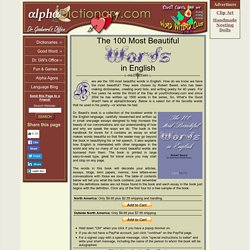
How do we know we have the most beautiful? They were chosen by Robert Beard, who has been making dictionaries, creating word lists, and writing poetry for 40 years. For five years he wrote the Word of the Day at yourDictionary.com and since 2004 he has written up 1500 words in the series, So, What's the Good Word? Here at alphaDictionary. Below is a select list of his favorite words that he used in his poetry—or wishes he had. Dr. The words in this book will decorate your articles, essays, blogs, term papers, memos, love letters-even conversations with those we love. Funny words English vs. German. Ambiguous Words. The words project. word list. Internet Anagram Server : The Anagram Hall of Fame. Tracking the Way We Use Language / Word association. Translations of useful phrases in many languages.
Lost in Translation - Cross-language computer translation. "Language is the source of misunderstandings.

" — Antoine de Saunt-Exupéry in The Little Prince Important: Systran, which for years provided our translation functionality, shut down their service in May. We're now using Google Translate. Unfortunately, the Google Translate API has been officially deprecated as of May 26, 2011. Google's API will be shut off completely on December 1, 2011.
Therefore, barring the emergence of new, publicly-available machine translation API, this site will disappear on December 1, 2011. What happens when an English phrase is translated by computer back and forth among a few different languages? Try it for yourself! Morse Code Translator. Translate Free Online. Ten Most Difficult Words to Translate. Sometimes even the finest translators come up against words that defy translation.
Many languages include words that don’t have a simple counterpart in another language. When translators come across such a word, they usually describe it so that it makes sense in the target language. But some words pose more difficulty than others due to interesting cultural differences. Evolution of Latin Characters. Omniglot - the guide to languages, alphabets and other writing systems. Ancient Scripts. What type of writing does the Indus script represent? How, then, is it possible to decipher an unknown system of writing?

Confronted with this primary question we are doubly fortunate in comparison to the decipherers of the Egyptian hieroglyphs more than 150 years ago. In the first place, we have a number of successful decipherments to look back to, both as potential models and as sources of inspiration, which reassure us in the indispensable belief that seemingly impossible feats can be achieved. Yet none of the earlier decipherments is directly comparable to the problem of the Indus script: most of them were based on a translation of a text in the unknown script into a known script and language, or at least the historical context provided crucial clues in the form of proper names.
Hobosigns. Hobo Signs These Hobo Signs below, plus a large glossary of Hobo Terms are available in printed form in my book "The American Hoboes" "Riders of the Rails".
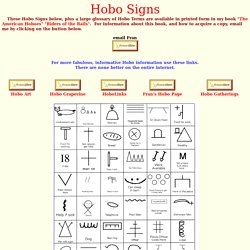
For information about this book, and how to acquire a copy, email me by clicking on the button below. email Fran For more fabulous, informative Hobo information use these links.There are none better on the entire internet. There may be one or more signs that give the same message or, at times, there may be slightly different meanings for a sign.
IdiomSite.com. The Evolution of Language. Words in English. A Brief History of English, with Chronologyby Suzanne Kemmer © 2001-2005 Pre-English | Old English | Middle English | Modern English The language we call English was first brought to the north sea coasts of England in the 5th and 6th centuries A.D., by seafaring people from Denmark and the northwestern coasts of present-day Germany and the Netherlands.
These immigrants spoke a cluster of related dialects falling within the Germanic branch of the Indo-European language family. Their language began to develop its own distinctive features in isolation from the continental Germanic languages, and by 600 A.D. had developed into what we call Old English or Anglo-Saxon, covering the territory of most of modern England. New waves of Germanic invaders and settlers came from Norway and Denmark starting in the late 8th century. The Norman Invasion and Conquest of 1066 was a cataclysmic event that brought new rulers and new cultural, social and linguistic influences to the British Isles.
Wordorigins.org. 1,600 Sayings, phrases and expressions - with their meanings and origins explained. Etymologically Speaking... From the old Arabic word "hashshshin," which meant, "someone who is addicted to hash," that is, marijuana.
Originally refered to a group of warriors who would smoke up before battle. Aaron White adds: You may want to explore the fact that the hashshshins were somewhat of a voodoo-ized grand conspiracy scapegoat cult (the very fact of their existence is impossible to confirm). They supposedly were a secret society (a la the FreeMasons) which was influential in every middle eastern court from Persia to Bangladesh. They were supposedly a brotherhood of assasins, devoted to their caballa and its secrecy, protected by an unlimited number of fanatical followers and unlimited material wealth. The Origin of Words and Names.
Online Etymology Dictionary. Etymologic: the toughest etymology (word origin) game on the Web. Pronunciator - Learn to Speak 60 Languages. Did Americans in 1776 have British accents? 90 Percent Of Languages Will Be Extinct Next Century - And Thats Good. Greek To Me. How Language Works. Speech Accent Archive.
"How Swearing Works" According to the "Hitchhiker's Guide to the Galaxy," the most offensive word in the universe is "Belgium.
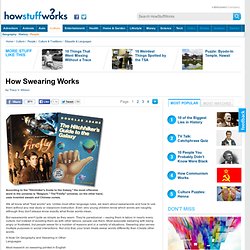
" The"Firefly" universe, on the other hand, uses invented swears and Chinese curses. We all know what "bad words" are. Unlike most other language rules, we learn about swearwords and how to use them without any real study or classroom instruction. Even very young children know which words are naughty, although they don't always know exactly what those words mean. But swearwords aren't quite as simple as they seem. In this article, we'll explore what makes words into swearwords, why most Americans use them and how society responds to swearing.
Non-Errors. 50 Problem Words and Phrases. Synonym Finder. Word List of Commonly Confused Words at Dictionary. Dirty 30s! - Slang of the 30s. Introduction | Timeline | Fashion | Slang | Price Guide | Can you spare a dime?

Nazis, Commies & the Mafia | Wars and Rumours of Wars Explorers, Daredevils & Record SettersAutomobiles | Ships, Trains & Planes | Hindenburg & Other AirshipsPistols & Revolvers | Rifles & Shotguns | Machineguns Architecture & Art Deco | The Big Apple | ...and all that Jazz!