
Free will? Home | Search Serendip Free WILL?
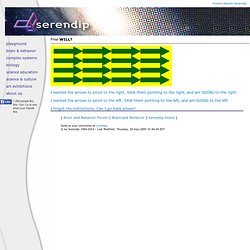
I wanted the arrows to point to the right, SAW them pointing to the right, and am GOING to the right I wanted the arrows to point to the left, SAW them pointing to the left, and am GOING to the left I forgot the instructions. Can I go back please? The 48 Laws of Power. Background[edit] Greene initially formulated some of the ideas in The 48 Laws of Power while working as a writer in Hollywood and concluding that today's power elite shared similar traits with powerful figures throughout history.[5] In 1995, Greene worked as a writer at Fabrica, an art and media school, and met a book packager named Joost Elffers.[4][8] Greene pitched a book about power to Elffers and six months later, Elffers requested that Greene write a treatment.[4] Although Greene was unhappy in his current job, he was comfortable and saw the time needed to write a proper book proposal as too risky.[10] However, at the time Greene was rereading his favorite biography about Julius Caesar and took inspiration from Caesar's decision to cross the Rubicon River and fight Pompey, thus inciting the Great Roman Civil War.[10] Greene would follow Caesar's example and write the treatment, which later became The 48 Laws of Power.[10] He would note this as the turning point of his life.[10]
Coping with Nietzsche's Legacy: Rorty, Derrida, Gadamer. Gary Brent Madison McMaster University madison@mcmaster.ca [From my forthcoming book, The Politics of Postmodernity: Essays in Applied Hermeneutics] I know my fate.
One day my name will be associated with the memory of something tremendous--a crisis without equal on earth, the most profound collision of conscience, a decision that was conjured up against everything that had been believed, demanded, hallowed so far. I am no man, I am dynamite. --Friedrich Nietzsche, Ecce Homo, "Why I Am a Destiny. " Proemium. The Death of Postmodernism And Beyond.
Articles Alan Kirby says postmodernism is dead and buried.

In its place comes a new paradigm of authority and knowledge formed under the pressure of new technologies and contemporary social forces. I have in front of me a module description downloaded from a British university English department’s website. It includes details of assignments and a week-by-week reading list for the optional module ‘Postmodern Fictions’, and if the university is to remain nameless here it’s not because the module is in any way shameful but that it handily represents modules or module parts which will be taught in virtually every English department in the land this coming academic year.
It assumes that postmodernism is alive, thriving and kicking: it says it will introduce “the general topics of ‘postmodernism’ and ‘postmodernity’ by examining their relationship to the contemporary writing of fiction”. An Essay by Einstein. "How strange is the lot of us mortals!

Each of us is here for a brief sojourn; for what purpose he knows not, though he sometimes thinks he senses it. But without deeper reflection one knows from daily life that one exists for other people -- first of all for those upon whose smiles and well-being our own happiness is wholly dependent, and then for the many, unknown to us, to whose destinies we are bound by the ties of sympathy. A hundred times every day I remind myself that my inner and outer life are based on the labors of other men, living and dead, and that I must exert myself in order to give in the same measure as I have received and am still receiving... "I have never looked upon ease and happiness as ends in themselves -- this critical basis I call the ideal of a pigsty. The ideals that have lighted my way, and time after time have given me new courage to face life cheerfully, have been Kindness, Beauty, and Truth. "My political ideal is democracy.
A . Philosophy since the Enlightenment, by Roger Jones. "Seven Blunders of the World" by Mahatma Gandhi. Are You Living in a Computer Simulation? Ð ¡ § © Ø ® Ð ¦ Å ñ . c o m. In Another city another me is writing; Another thought is unwinding. Squashed Philosophers Abridged Editions. Existential Primer. An overview of this absurd space Since 1996, The Existential Primer has provided an introduction to existentialism and the related Continental philosophies.
As a primer, the website explores connections between many individuals, works, and concepts instead of offering narrow specialization. Scholars appreciate the need for both narrow and broad analyses, which serve different purposes. When you read each section, do not expect narrowly focused depth — by definition, this website offers a survey of the topics and individuals important to existentialism. To locate book-length analyses of one thinker — or one work by that individual — use the complete bibliography.
My passion is creative writing and how “creative” works affect social change. As a playwright, I appreciate that art reaches wider audiences than most scholarship. How do we construct meaning as societies if existence is meaningless? The Individual Defines Everything. Philosophical Dictionary. Philosophy Timeline. Western Philosophy. Taxonomy of the Logical Fallacies. TEACHINGS OF DIOGENES. Dream Analyzer. The Tibetan Book of the Dead. NoZen. Zen Stories to Tell Your Neighbors.
Tao te ching. Koan : The Moon Cannot Be Stolen.