
Silly Origami Folds. This somewhat sparse page is dedicated to silly origami folds.
Why not? They may be silly, but they are also useful. Enjoy! Fold laundry shirts in 10 seconds (ORC) Fold plastic grocery bags into tidy triangles (ORC) Fold chip bags so chips don't spill out (ORC) Fold brown paper bags so they have handles (ORC) Fold a chopstick wrapper into a chopstick stand (ORC) Fold a chopstick wrapper into an origami bird (ORC) Fold a chopstick wrapper into an origami heart (ORC) Chopstick Rest or make a chopstick wrapper (Gerardo)Chopstick Rest from square paper (D Engleman)
Techniques. Biodegradable Pots for Seedlings: Origami Newspaper Method. Origami. Origami Resource Center: free diagrams, origami history, Sadako, book reviews. Easy origami. Easy Origami Envelope Folding Instructions - How to make an Easy Origami Envelope. This is a great one - the easy origami envelope.
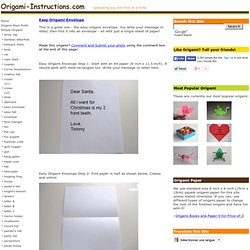
You write your message or letter, then fold it into an envelope - all with just a single sheet of paper! Made this origami? Comment and Submit your photo using the comment box at the end of this page! Easy Origami Envelope Step 1: Start with an A4 paper (8 inch x 11.5 inch). It should work with most rectangles too. Easy Origami Envelope Step 2: Fold paper in half as shown below. Easy Origami Envelope Step 3: Fold the top right down to meet the center crease.
Easy Origami Envelope Step 4: Now fold the bottom left to meet the center crease. Easy Origami Envelope Step 5: Now fold the right side to meet the left vertical edge. Easy Origami Envelope Step 6: Fold the left side to meet the right vertical edge. Easy Origami Envelope Step 7: Rotate the paper 90 degrees clockwise: Easy Origami Envelope Step 8: Fold the right side down to meet the bottom edge. Easy Origami Envelope Step 9: Open the bottom flap and tuck in the right side. Creative Kismet » Blog Archive » little guiding stars. Since the new year has started I’ve been trying to think of ways to be more kind to my self.
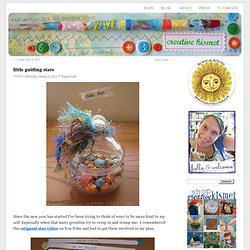
Especially when that nasty gremlins try to creep in and stump me. I remembered this origami star video on You Tube and had to get them involved in my plan. I thought it would be fun to make a whole bunch with kind words and “you are….” phrases inside. I made 60 of them, enough to last me the whole year if I open one a week, plus a few extra just in case. I used 12 x 12 inch scrapbook paper and cut 1/2 x 12″ strips, then followed the video HERE*. *UPDATE! Be Sociable, Share! Origami. Origami Diagrams. I thought of sharing some of the diagrams I have been collecting over the last few months from various websites.
These are available freely over the Internet and are mostly in the PDF format. I still haven’t gotten around to folding most of these as yet. For some of these models, I have found instructional videos on YouTube; and have provided links to view these PDF files as well as instructional videos accordingly. For more videos, please check out the category Instructional Videos on this site. In this category are those tutorials recorded by me. Origami. The folding of an Origami crane Origami (折り紙?
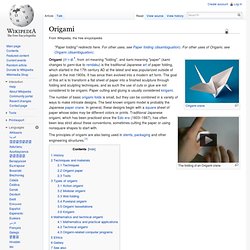
, from ori meaning "folding", and kami meaning "paper" (kami changes to gami due to rendaku) is the traditional Japanese art of paper folding, which started in the 17th century AD at the latest and was popularized outside of Japan in the mid-1900s. It has since then evolved into a modern art form.
The goal of this art is to transform a flat sheet of paper into a finished sculpture through folding and sculpting techniques, and as such the use of cuts or glue are not considered to be origami. Paper cutting and gluing is usually considered kirigami. The principles of origami are also being used in stents, packaging and other engineering structures.[1] History There is much speculation about the origin of Origami. In China, traditional funerals include burning folded paper, most often representations of gold nuggets (yuanbao).
The earliest evidence of paperfolding in Europe is a picture of a small paper boat in Tractatus de sphaera mundi from 1490.