
Risk management. Risk management is the identification, assessment, and prioritization of risks (defined in ISO 31000 as the effect of uncertainty on objectives) followed by coordinated and economical application of resources to minimize, monitor, and control the probability and/or impact of unfortunate events[1] or to maximize the realization of opportunities.
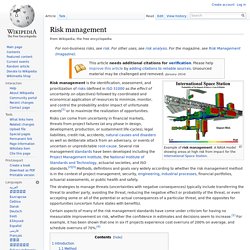
The strategies to manage threats (uncertainties with negative consequences) typically include transferring the threat to another party, avoiding the threat, reducing the negative effect or probability of the threat, or even accepting some or all of the potential or actual consequences of a particular threat, and the opposites for opportunities (uncertain future states with benefits). Introduction[edit] Innovation andrisk management. Enterprise Risk Management Init.
By: ERM Initiative Faculty and Amy Claus, 2010 Master of Accounting Student The cover stories in the October 2009 issue of Harvard Business Review focus on the current state of risk oversight.

The lead story focuses on how many people wonder why nobody seemed to see the financial crisis coming before it actually hit. While some experts may chalk it up to a black swan event, most believe that it was because professionals did not have a clear view of how several risks were interacting and building on one another to create the potential for such a crisis. It was a combination of the innovation of risky new products, motivation due to performance pressure and the rationalization of actions due to the shareholder value principle.
This is the belief that social welfare is somehow best served if managers only focus on returning the maximum value to stock holders, thereby encouraging managers to take on risk. Risk: A 4-Letter Word? « Stoneroad’s Blog. When you hear the word “risk”, do you run away in panic believing it’s something that should be avoided at all costs; something that if you ignore, simply goes away?

Disappears? Many organizations and their management teams – of all levels – have such negative reactions when they hear that 4 letter word that it’s hard to believe we progress at all. Yet, in business, and in fact in our daily lives, it’s almost impossible to achieve some level of success without taking a level of risk. Would we be flying in ten-ton aircrafts (and that’s probably light) if the Wright Brothers hadn’t taken a risk?