
PCR Virtual Lab. Primers are short pieces of DNA that are made in a laboratory.

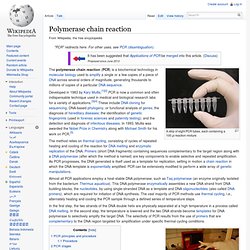
Since they're custom built, primers can have any sequence of nucleotides you'd like. In a PCR experiment, two primers are designed to match to the segment of DNA you want to copy. Through complementary base pairing, one primer attaches to the top strand at one end of your segment of interest, and the other primer attaches to the bottom strand at the other end. Polymerase chain reaction (PCR) Polymerase chain reaction. A strip of eight PCR tubes, each containing a 100 μl reaction mixture The polymerase chain reaction (PCR) is a biochemical technology in molecular biology used to amplify a single or a few copies of a piece of DNA across several orders of magnitude, generating thousands to millions of copies of a particular DNA sequence.
Placing a strip of eight PCR tubes, each containing a 100 μl reaction mixture, into the thermal cycler PCR principles and procedure[edit]