
Creative Kids Education Foundation. Mission: The Creative Kids Education Foundation is a non-profit educational organization founded in l996.
The mission of the Foundation is to design and support innovative programs in classical music education and the arts and humanities for young people. The Creative Kids Education Foundation is a non profit educational organization founded in l996 by J. Kirk Mathews, co-founder of Xircom. Learning From Lyrics ©1996-2012. Incredible Art Department. Because Common Core promotes the importance of all students studying the arts, we have highlighted places where ELA instruction could be enhanced by connecting a work of literature or an objective of.
Museum ed. National Assembly of State Arts Agencies. Executive Function, Arts Integration and Joyful Learning (Part 6 of 7) When students know they will have opportunities to use artistic, kinesthetic or manipulative experiences in the course of learning and as part of their learning assessments, their optimism is renewed.
Knowing from the start that they will create representations of their learning through visual, musical or movement expressions (ideally with a medium of their choice) is an inoculation against boredom and low effort. When the brain has reasons to expect that something previously pleasurable will soon happen, such as when a creative activity will be part of new learning, that expectation results in increased release of the neurotransmitter dopamine, which increases pleasure and reduces stress.
What is Useful? The paradox of rights in Tania Bruguera’s ‘Useful Art’ Immigrant Movement International.
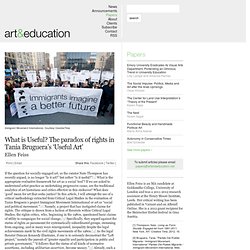
Courtesy CreativeTime If the question for socially engaged art, as the curator Nato Thompson has recently argued, is no longer “Is it art?” ArtsEdge Educators Portal. National Art Education Association.