
Freedom of speech. Eleanor Roosevelt and the Universal Declaration of Human Rights (1949).
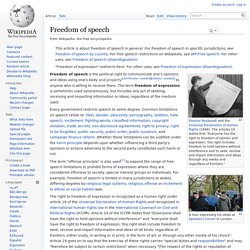
The articles 19 states that "Everyone has the right to freedom of opinion and expression; this right includes freedom to hold opinions without interference and to seek, receive and impart information and ideas through any media and regardless of frontiers. " Freedom of speech is the political right to communicate one's opinions and ideas using one's body and property[clarification needed][citation needed] to anyone who is willing to receive them. The term freedom of expression is sometimes used synonymously, but includes any act of seeking, receiving and imparting information or ideas, regardless of the medium used. Every government restricts speech to some degree.
The term "offense principle" is also used[1] to expand the range of free speech limitations to prohibit forms of expression where they are considered offensive to society, special interest groups or individuals. Origins[edit] Democracy[edit] Limitations[edit] Freedom of speech in the United States. Freedom of speech in the United States is protected by the First Amendment to the United States Constitution and by many state constitutions and state and federal laws.
The freedom of speech is not absolute; the Supreme Court of the United States has recognized several categories of speech that are excluded from the freedom, and it has recognized that governments may enact reasonable time, place, or manner restrictions on speech. Criticism of the government and advocacy of unpopular ideas that people may find distasteful or against public policy are almost always permitted. There are exceptions to these general protections, including the Miller test for obscenity, child pornography laws, speech that incites imminent lawless action, and regulation of commercial speech such as advertising. First Amendment[edit] The First Amendment to the United States Constitution codifies the freedom of speech as a constitutional right. Early history[edit] England[edit] Colonies[edit] In New York Times v.
O’Reilly Tonight: Is Bullying Free Speech? « John Stossel. Bullying. Mass law and responsibility for bullying in schools. May 7th, 2010 Mass law and responsibility for bullying in schools On May 3, Massachusetts Gov.

Patrick signed into law (with much fanfare) S2404, a bill that languished until two headline-grabbing student suicides were traced to bullying by other students. Middle school student Carl Walker-Hoover hanged himself in 2009 and high school student Phoebe Prince did the same in Jan. 2010. Legislation was reflexively proposed to hold adults (educators, paraprofessionals, administrators, school nurses, cafeteria workers, etc.) responsible for stopping bullying when they see it or at least report it to the school principal. Back on March 18, the MA State House passed a version of the bill 148-0 in the aftermath of reports that Irish transplanted high school student Prince was still being mocked long after her death on social media sites by the same teens that had tormented and taunted her right up to her last day of life. The final bill is S2404 and you can read it in its entirety here.
Is School Bullying Protected Speech? - Fox News Video - FoxNews.com. Is School Bullying Protected Freedom of Speech? - Bill O'Reilly.