
background preloader

Read

Facebook Twitter

Do not stand at my grave and weep. Do Not Stand at My Grave and Weep is a poem written in 1932 by Mary Elizabeth Frye. Although the origin of the poem was disputed until later in her life, Mary Frye's authorship was confirmed in 1998 after research by Abigail Van Buren, a newspaper columnist.[1] Full text[edit] Do not stand at my grave and weep, I am not there; I do not sleep. I am a thousand winds that blow, I am the diamond glints on the snow, I am the sunlight on ripened grain, I am the gentle autumn rain. When you awaken in the morning’s hush I am the swift uplifting rush Of quiet birds in circled flight. I am the soft stars that shine at night. Do not stand at my grave and cry, I am not there; I did not die. Origins[edit] Mary Frye, who was living in Baltimore at the time, wrote the poem in 1932. Mary Frye circulated the poem privately, never publishing or copyrighting it.

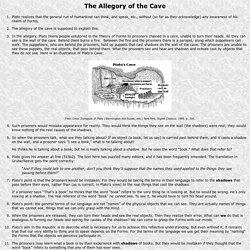
The poem was introduced to many in Britain when it was read by the father of a soldier killed by a bomb in Northern Ireland. BBC poll[edit] ... Rocky J. Allegory of the Cave. Plato realizes that the general run of humankind can think, and speak, etc., without (so far as they acknowledge) any awareness of his realm of Forms. The allegory of the cave is supposed to explain this. In the allegory, Plato likens people untutored in the Theory of Forms to prisoners chained in a cave, unable to turn their heads. All they can see is the wall of the cave. Behind them burns a fire. From Great Dialogues of Plato (Warmington and Rouse, eds.) Here are some students’ illustrations of Plato’s Cave Go back to lecture on the Phaedo Go back to lecture on the “One Over Many” Argument Go to next lecture on Criticism of Forms Need a quick review of the Theory of Forms? Return to the PHIL 320 Home Page Copyright © 2006, S.
Run your fingers over the letters by Megan McClain. You don't understand at all do younot trulyyou thinkI'm a liarthat I still hold the knifethatstabbed you in the back[and in the heart] kinda speechlessthat you feel that waythink that waybelieve ituntrustworthy? Misleading? False emotions? Can you not read? It's like when the clouds stormy eyeswelled up and let fall the tears of weekend rainsoggy, we laughed along with the thunderand under our waterfall we let the windowsfogtell me I lied then or picture if you willstanding by the tree I always parked byit was a starry night, but we didn't see itwe were too focused on our facesexceptwhy is it I was the only onedrowning in the sadness that overtook my eyesshaking with each strained, choppy breathclutching that gray shirt like a life jacketdo you think that was allfor show?
If soif I am that liar with the knife who led you astray and "screwed you over"let you down, kicked you aroundif you can't seem toopen your eyesand noticejust how much I love youjust how much I always have. Whole by Katrina Wendt.

Thought Catlog

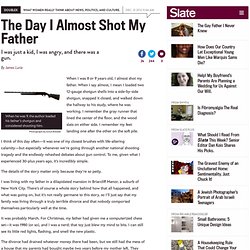
Theobviouslife. The day I almost shot my father: I was young, angry, and holding a gun. Photograph by Goce Risteski When I was 8 or 9 years old, I almost shot my father. When I say almost, I mean I loaded two 12-gauge shotgun shells into a side-by-side shotgun, snapped it closed, and walked down the hallway to his study, where he was working. I remember the gray runner that lined the center of the floor, and the wood slats on either side. I remember my feet landing one after the other on the soft pile. I think of this day often—it was one of my closest brushes with life-altering calamity—but especially whenever we’re going through another national shooting tragedy and the endlessly rehashed debates about gun control.
To me, given what I experienced 30-plus years ago, it’s incredibly simple. The details of the story matter only because they’re so petty. I was living with my father in a dilapidated mansion in Briarcliff Manor, a suburb of New York City. It was probably March. My cheeks seared; rage surged. And then, about midway down the hallway, something amazing happened.